
The influence of Islam in Europe On centrifugal movement and formative power as characteristics of European civilisation
Every vital civilisation is like a centrifuge, in which the boundaries of one’s own psyche are pushed as far outwards as possible, whilst remaining constantly centred on one’s own core. This gives rise to that living tension between self-preservation and self-loss, which is known only to those who have chosen the third way.
— Fokke Sierksma, Beauty as Self-Interest (1948), p. 24
Islam is all the rage in certain circles. According to advocates of diversity, it enriches our civilisation. Some even claim that, historically speaking, Europe would be inconceivable without the influence of Islam. Elizabeth Drayson also belongs to this latter category.
Her book Europe’s Heritage has a telling subtitle: How Islam shaped our history.
Drayson is a professor at Cambridge. In the past, that would have been a guarantee of a well-founded argument. Recently, however, some doubts have rightly arisen in this regard—notably because ideological fads have been given priority over academic rigour. And now her assertion that our civilisation is not an autonomous, indigenous development, but has been decisively shaped by ‘foreign’ influences, just so happens to fit perfectly into today’s fashionable trend.
Admittedly, in the distant past, Europe was indeed enriched by numerous elements from Islamic culture. But must we not also acknowledge that our continent subsequently displayed a creativity which led to a historically unprecedented degree of freedom and prosperity—without this being attributable in any way whatsoever to Islam?
An age-old fascination
Once again: there is no doubt that Islam has influenced the formation of Western civilisation.
The scholar of religious studies from whom I learnt the most during my studies was Fokke Sierksma (1917–1977), who had already been dead for years by then. It was he who, in his inaugural lecture entitled A Few Thoughts on the Muslim Contribution to European Civilisation (1974), demonstrated that Western culture owed far more to the Islamic world than was generally assumed at the time. Not only did Aristotle reach Western Europe via Arabic translations and commentaries; in the fields of medicine, astronomy, mathematics, agriculture and trade, too, the Islamic world proved to be an indispensable link in the history of Europe for centuries.
Sierksma was also the one who had previously taken a stand in the debate that had been raging in the literary world since the 1930s over the question of what was more important: the form of the work of art or the creative power of the artist manifested through the work of art. (For enthusiasts of this debate: J.J. Oversteegens’ Form or Artist: Views on the Nature of the Literary Work in Dutch Criticism between the Two World Wars offers a still unrivalled overview of the discussion at the time.)
Translated to the level of an entire civilisation: why do some civilisations become paralysed when confronted with something ‘foreign’, while others remain open to foreign influences when these are capable of enriching them? Sierksma’s answer to that question was clear: only a vibrant culture possesses the centrifugal forces to assimilate the foreign into itself in a way that strengthens its creative potential. He called this ‘the third way’ between self-preservation and self-loss. By contrast, the two tendencies of self-preservation and self-loss are precisely the hallmarks of weak, complacent and decadent cultures; because they cannot withstand the tension between the two, they will sooner or later implode.
A weak culture copies; a complacent culture closes itself off. But a vital culture does something different. It is open, selects, adopts, assimilates and recreates. It draws inspiration from what is foreign, whilst at the same time making it serve its own life principle. In short, a vibrant culture is like a person with a unique creative power. Here, form is a living organising principle that allows new elements to play a creative role in the shaping of its own civilisation.
This is how Sierksma viewed the influence of Islam: not as something that forged our civilisation, but as a source of elements valuable in their own right, which were utilised by a way of life possessing a creative power all of its own.
A necessary correction
With all this in mind, I began reading Drayson’s The Heritage of Europe. She rightly corrects the still-prevailing left-liberal view that became dominant from the nineteenth century onwards and which even people such as Sierksma failed to revise. In this view, Europe appears as an autonomous civilisation that, via Athens, Rome and the Renaissance, developed through the Enlightenment into the modern culture that heralded the end of history. The Islamic world constituted, at most, a threat which—heroic as we were at Poitiers, Vienna and Lepanto—could only just be kept at bay.
In the light of the facts, this view is no longer tenable. Drayson convincingly demonstrates just how porous the boundaries between the two worlds have always been. Travelling via al-Andalus, Sicily, Byzantium and the Mediterranean were not only merchants and soldiers, but also manuscripts, techniques, ideas and scientific insights. In European history, Islam turns out not to have been merely an enemy, but a civilisation which, through constant exchange, has also left its indelible mark on the West. Indeed: anyone who imagines European history without Córdoba, Toledo or Palermo does it a disservice.
However, Drayson cannot escape the tendency to allow herself to be carried away by her own enthusiasm for her ‘new’ perspective. For her claim is not so much that Islam has enriched European civilisation; her narrative serves to underpin the suggestion that, without the influence of this culture, our continent would still be at the mercy of barbarism.
This leads to a number of controversial claims which, in my view, require correction.
Córdoba and the ‘barbaric’ Franks
To begin with: Drayson’s description of al-Andalus. No one would deny that, in the tenth century, Córdoba was one of the most impressive cities in Europe. Its libraries, irrigation systems, medical knowledge, philosophy and courtly culture made a deep impression on contemporaries.
In contrast, she paints a picture of Europe that comes across as rather bleak. In it, the Franks appear as barbarians: crude, undeveloped and culturally utterly backward. This is an understandable rhetorical contrast, but historically less convincing.
It was precisely during those same centuries that a development took place under the Carolingians whose significance can hardly be overestimated. The reform of education, the founding of monastic schools, the standardisation of Latin, the development of the Carolingian minuscule and, above all, the systematic copying of classical texts laid the foundations for virtually everything that would later come to be known as Latin scholarship.
It is a quiet form of civilisation. It did not yet possess the architectural splendour characteristic of the Caliphate. It did not build religious centres such as al-Mezquita or palaces such as Madīnat al-Zahrā’. But without that seemingly modest monastic labour, we would simply no longer be familiar with much of Virgil, Cicero, Tacitus and Augustine today.
What would Emperor Charlemagne have made of it?
I have a second objection to her treatment of historical sources. Every historian knows that medieval chronicles do not offer neutral accounts. They are written from the perspective of religious convictions, political interests and dynastic loyalties. This applies just as much to Christian chroniclers as it does to Islamic ones.
At the same time, Christian sources are read with greater suspicion than Islamic ones. When a Christian chronicler describes a victory, propaganda motives are quickly pointed out. That is justified. But I missed the same scepticism when Islamic authors recount their own history.
Historical writing gains in persuasiveness when it applies the same standards to all its sources and does not merely use them to substantiate its own position. I shall take as an example her assessment of one of the best-known episodes in the book: the conversion of the aforementioned Mezquita, the Great Mosque of Córdoba.
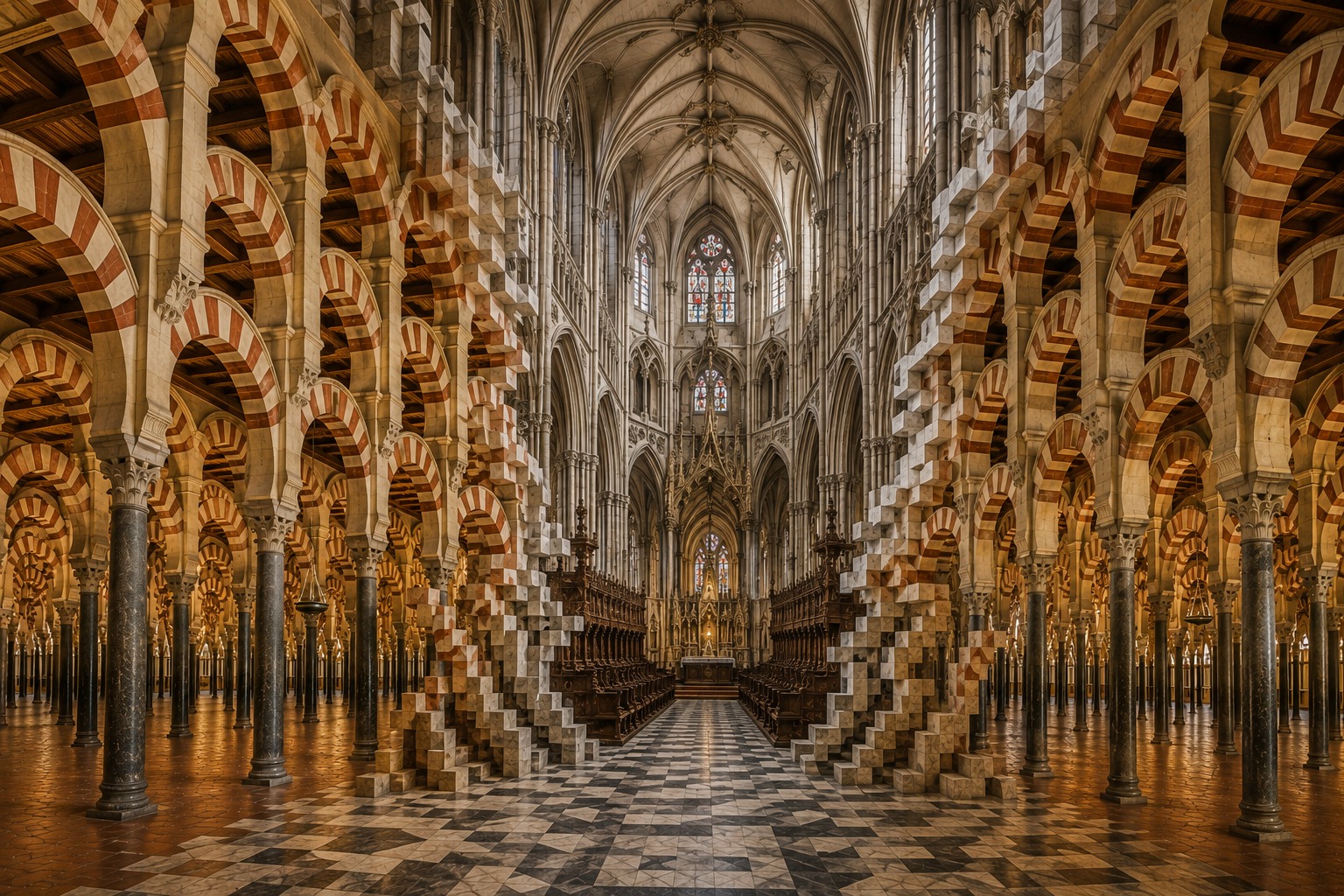
Following the capture of the city by King Ferdinand III of Castile in 1236, the Great Mosque was converted into a cathedral. Rather than demolishing the existing structure, the Christian rulers chose to incorporate it into their religious architecture. This gave rise to the unique fusion of Islamic and Christian elements that characterises the Mezquita to this day.
The most significant change during this period was the construction of the so-called Capilla Mayor, the great cathedral nave at the heart of the mosque. Drayson describes how radically the incorporation of the Gothic nave altered the character of the mosque. And to convey just how terrible an assault this was on the beauty of the original structure, she quotes a statement attributed to Emperor Charles V: “You have destroyed what was unique in order to build what can be seen everywhere.”
It is, of course, marvellous that even a Westerner is able to recognise the barbaric nature of this distortion of the Islamic original. But quite apart from the historical reliability of the statement itself, its uncritical use to make one’s own point is not something a renowned Cambridge historian ought to be guilty of.
A different perspective on Córdoba
Drayson describes the mosque primarily as the pinnacle of Islamic civilisation, which was later desecrated by Christian barbarians.
Yet at the same time, the very same building also tells a different story. After all, the mosque was erected on the site of the Visigothic Church of St Vincent. Roman columns and capitals were reused in its construction. And when Caliph al-Hakam II had the magnificent mihrab embellished, Byzantine mosaic artists were invited from Constantinople for this purpose.
This raises the fundamental question of what, apart from the building’s religious character, is ‘Islamic’ about the mosque. It is far more obvious to view it as a multi-layered work of art in which Roman, Visigothic, Syrian and Byzantine traditions converge.
Admittedly, the mosque was built by people who were also Muslims, but is that sufficient to call its architecture ‘Islamic’?
As far as I am concerned, that is only possible if we view ‘Islam’ here as a civilisation that possessed the ability not merely to adopt foreign traditions, but to incorporate them into a new context.
As such, the original mosque must have been a marvel of beauty. Enough of it remains to still leave one deeply impressed. But there is little reason to make such a dramatic fuss about the incorporation of the cathedral as Drayson does—let alone for her to invoke an alleged quotation from Emperor Charles.
Indeed: the cathedral section, the aforementioned Capilla Mayor, stands in stark contrast to the architecture of the older mosque sections surrounding it. The tall, vertical, massive and centrally organised cathedral rises out of the low, horizontal, rhythmic ‘forest’ of double arches. At that level, the contrast is indeed enormous.
At the same time, the cathedral does not stand apart from the mosque, but forms a new historical and architectural layer within it. The materials, the play of light, the rhythm, the ornamentation and, above all, the monumentality ensure that, despite the contrast, the whole is nevertheless experienced as a single monument.
Whilst the mosque is characterised by an almost infinite horizontal rhythm, the cathedral introduces a vertical concentration into it. It creates a centre where, originally, it was precisely the rhythm of the colonnade that dominated. This is not so much a ‘barbaric mutilation’ as a historical addition which does not destroy elements that might be perceived as ‘foreign’, but rather integrates them and forges them into a ‘new’ whole.
Europe as a civilisation of the third way
The cathedral-mosque of Córdoba may thus well symbolise what Sierksma called ‘the third way’. By this he meant the following. Europe does not draw its life from a single cultural centre of its own. For, indeed, our continent continually draws its spiritual resources from sources that lie beyond itself.
The Romans recognised the superiority of Greek culture and appropriated its valuable elements. Christianity received its sacred scriptures from Israel. Medieval universities often became acquainted with Aristotle through Arabic translations and commentaries. Later, during the Renaissance and the Reformation, Europe would once again – but this time much more directly – draw inspiration from Byzantium, from the rediscovery of classical antiquity and the sources of ancient Israel.
What characterises Europe, therefore, is not so much a particular cultural essence as a continuous centrifugal movement in which ever-new elements form connections with one another, enabling the vital force that was its own to manifest itself in ever-new forms.
From centrifugal movement to formative power
Vital civilisations capable of achieving greatness were characterised not only by this centrifugal orientation, but also by something I would like to call formative power. Alongside the ability to tap into sources and bring them within its reach, it is important to make them fruitful and to give them a new form of its own. This raises the crucial question: what enables these civilisations to actually make the sources from which they draw inspiration fruitful?
A weak culture can develop in two directions. It clings desperately to old forms out of fear of losing itself. That fear is so great that it is unable to see that those old forms have long since ceased to be relevant to everyday life. It can also fall into the other extreme. In that case, it allows itself to be so overwhelmed by foreign influences that it loses its own identity. In doing so, it loses touch with the impulses that once made it great and enabled it to incorporate the foreign into an innovative whole that did justice to its own vitality.
A vibrant culture acts differently. It is curious without becoming uncritical. It is receptive without becoming dependent. It appropriates the foreign, but does not allow it to remain foreign. Just as a living organism absorbs food and transforms it into its own tissue, so a vibrant civilisation processes external influences into components of a new creation of its own.
That is what we saw in ancient Israel, in Athens, in Rome and in Baghdad. But also in Córdoba—not only when the Muslims ruled there, but certainly also when Christian civilisation gained the upper hand.
What all these civilisations have in common is the will to create something that reflects the way in which they experience reality and wish to organise their world. In doing so, they make use of every possible technique that can help them realise their vision—socially, economically, politically, religiously, but certainly also architecturally—in a manner that had never been seen before.
Córdoba: the decisive role of Emperor Charles
Even after the Reconquista, when Spain once again came under Christian rule, it was by no means a foregone conclusion that anything would change regarding the Mezquita. The city council wished to preserve the building in the state in which it had been handed down to them: the Islamic synthesis of Syria, Byzantium and Rome.
But by then, of course, the mosque was no longer a mosque, but had become a church. The local bishop felt that this should also be reflected in the architecture of the complex. He already knew exactly how this should be done; architects had told him what the whole complex should look like. However, without the city council’s permission, he could not proceed.
It was only when Emperor Charles V intervened that the deadlock was broken: he, too, felt that something had to be done. It went without saying that this would not be in the style that characterised the traditional complex. Apparently, he had less of a problem with this than the earlier quotation, so enthusiastically embraced by Drayson, might suggest.
Interplay of horizontal lines and verticality
And so, from the first quarter of the 16th century, a Gothic cathedral rose up in the heart of the ancient mosque. The beauty of the original was preserved in the process. Emperor Charles, too, had no objection to this. Yet at the same time, the character of the whole structure changed drastically due to the sea of light that arose in its centre.
Whilst the horizontal structure had previously dominated, this was now disrupted by the vertical orientation characteristic of the Gothic architectural style, which had developed over the preceding centuries from ‘barbaric’ northern France. The same pointed arches were used as those employed by master builders in the Islamic world. But in Christian Europe, they were put to a different use. No longer did they serve merely as an ingenious structure to support the roof, but as a means of transforming cathedrals into places where sunlight could flow freely.
This brought together technical refinement and the quest for light at the end of the so-called ‘Dark’ Ages. And although it marked the final throes of Emperor Charlemagne’s political rule, the symbolic power of the end result was irreplaceable for the triumph of Christianity in Europe.
To this day, the Mezquita-Catedral of Córdoba is regarded as an architectural highlight in world history—a highlight in which centrifugal movement and formal power are brought together in an unrivalled manner.
A product of Islamic formal power?
That said, we must acknowledge that—contrary to Drayson’s claim—even in Córdoba, it was not Islam that forged our civilisation.
This may well have been the case in Spain up until the 9th and 10th centuries. The knowledge and techniques they brought with them from Syria and Byzantium enriched our civilisation during that period. Traces of this are still visible everywhere—both physically and intellectually.
But it was Europe itself that made that knowledge and the accompanying technical ingenuity its own and enriched it with its own creativity in a way that has not been seen in the Islamic world since.
Plato and Aristotle—just like Islamic philosophers such as al-Fārābī, Avicenna and Averroes—did indeed provide important building blocks for Thomas Aquinas’s Summa Theologiae. But as early as the late Middle Ages, their thinking, like that of Thomas himself, came under sharp criticism, and Europe set out on new paths.
We see a similar development much earlier in architecture. Islamic culture familiarised the West with architectural styles from the Middle East and integrated them with Romanesque stylistic elements and techniques. But in the Gothic period, all of this took a new direction that cannot in any way be traced back to the orientation that characterised Islamic architecture.
Europe: a fully-fledged entity for some time now
In the original title of her book, Drayson speaks of a ‘Crucible of Light’. Yet that light is of a different order altogether from the light that still streams in every day through the sky-high windows of Córdoba Cathedral. If Islam did indeed ‘forge’ our civilisation, its role was limited to that of a blacksmith’s apprentice. The actual blacksmithing was, after all, ultimately carried out by the descendants of those ‘barbaric’ Franks.
Or, to use the terms of the ‘form or substance’ debate in which my mentor Sierksma was once a belated participant: the Islamic ‘substance’ that gave Córdoba its form had already died out in the Middle Ages. Even though Emperor Charles certainly had the necessary respect for that ‘substance’, he also knew that it was time for Europe itself to finally become a true ‘substance’.
Córdoba would no longer be the cultural centre of Europe. Florence, Amsterdam, London, Vienna and Paris completely eclipsed it—without needing Islamic civilisation to do so.
Europe, as a civilisation, proved capable of producing a relatively highly developed middle class; it proved culturally and technologically capable of giving rise to capitalism and, later, the Industrial Revolution; it developed a vibrant civil society as a counterweight to power-hungry rulers; and it developed a form of religious tolerance that is historically unparalleled.
Islamic culture offers little or no basis for any of these developments—let alone having made even the slightest contribution to them.
Finally
In itself, it is understandable that books such as Drayson’s seek to trace the conquest of Spain by the ancient Berber tribes back to the heyday of Islamic civilisation in the 10th century. We in Europe are currently also experiencing a period of cultural decline. But it is too simplistic to reduce everything that has happened between the 10th century and the present day to a product of that period in history. In my view, this tendency is more a form of decadence than a sign of renewed vitality.
In response to:
Elizabeth Drayson, Crucible of Light: Islam and Europe from the 8th to the 21st Century (Picador, 2025).
Hans van de Breevaart
Senior Researcher at the Renaissance Institute, the Think-Tank of FVD.
Senior Researcher at the Renaissance Institute, the Think-Tank of FVD.
Related articles
 Culture
The state as a work of art
 Culture
The Road Home: Reflections on Christopher Nolan’s The Odyssey
 Culture