The hour has struck: Europe between self-revelation and renewal: A reflection on the root causes of the European crisis
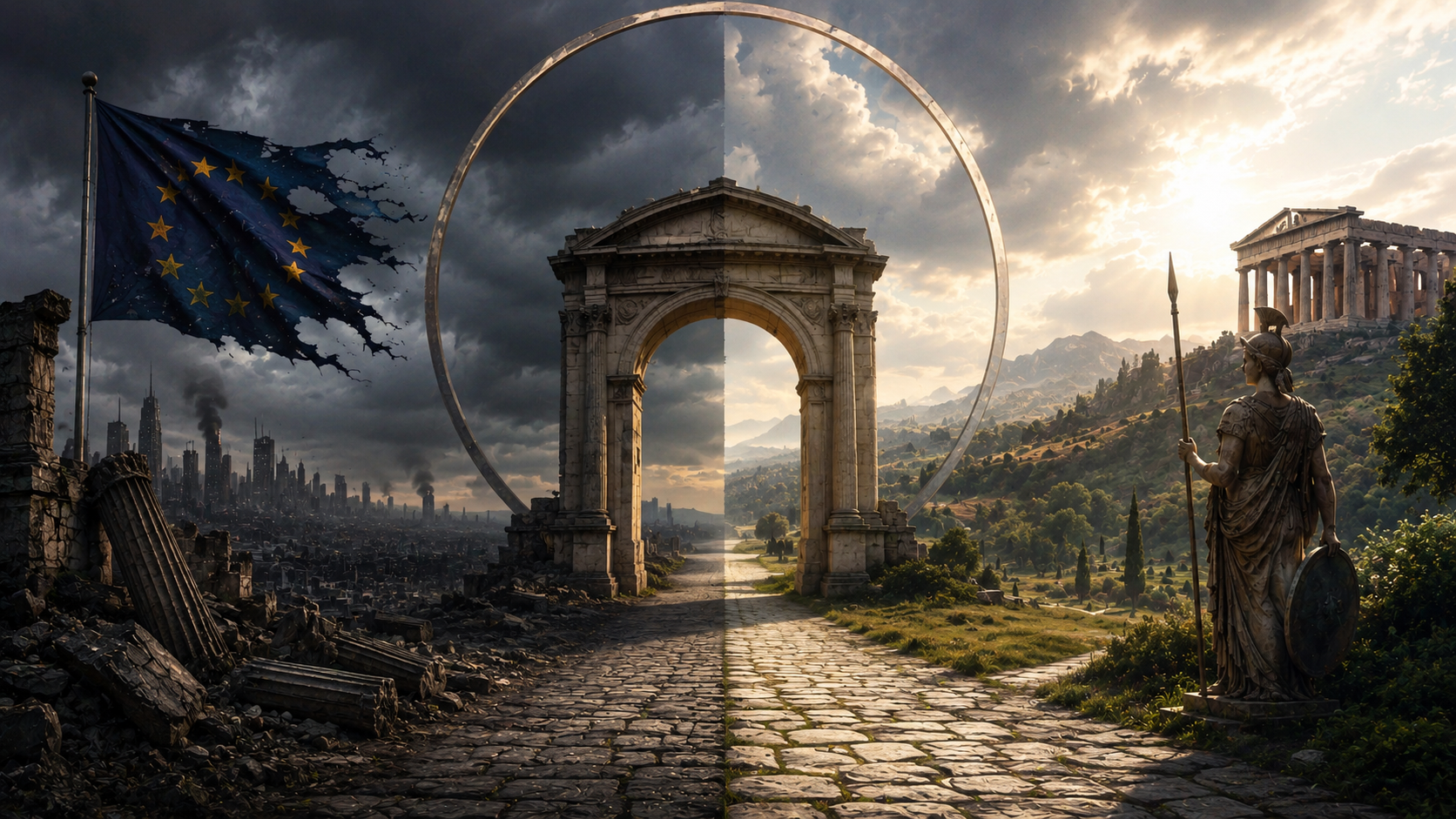
The catalyst for this article was the question of whether the current mass migration is a coincidence, a necessity or a deliberately orchestrated project. The question is a valid one and it deserves a clear answer. However, anyone seeking not merely an answer but one that stands up to the reality of the situation, and from which effective solutions can be derived, must look deeper.
All three interpretations, however different they may sound, share a tacit assumption. They treat migration as the actual starting point, as the cause from which Europe’s current crisis originates. This assumption is the real problem. The movement of millions of people to Europe is not the beginning of a development, but its most visible consequence. It is the symptom through which an underlying ailment finally becomes visible to the naked eye.
The crucial question is therefore not whether this movement was planned or simply happened. It is why an entire continent could have found itself in a state where such a movement became possible and, for years, met with hardly any serious resistance. It is not migration that is the real mystery, but Europe’s willingness to allow it to happen. Anyone who fails to understand this willingness will be unable to explain or manage migration, no matter what measures they take.
An answer which merely addresses the symptom may be reassuring but it will solve nothing. Borders can be secured, procedures tightened, and deportations organised; yet the underlying situation would remain unchanged for as long as the causes which rendered Europe defenceless in the first place continue to operate. These causes are not primarily demographic or legal in nature. They are cultural and moral. And the following observation applies to them.
The visible situation
Before inquiring into the causes, it is worth taking a sober look at what is measurable. In a debate heavily fuelled by emotions, figures have a value of their own. They refute the accusation that judgements here are based on resentment, and they force both sides onto common ground. Anyone who takes them seriously, however, must take them in their entirety – with their limitations as well as with what they indisputably reveal.
Germany lends itself to this analysis like hardly any other country. For over a decade, it has recorded particularly high intake figures, and where the figures were highest the consequences are most clearly evident. What can be observed here is therefore not a German special case, but a foretaste of what lies ahead for other European countries or has already befallen them. The following findings have been carefully selected. They are not based on individual cases – which can always be found – but on the official statistics themselves, and they concern those areas where the usual explanation holds the least weight.
Four findings take centre stage, and each is officially documented. The first concerns knife attacks. In 2024, the police recorded around 29,000 offences in which a person was threatened or attacked with a knife; the following year, the figure remained virtually unchanged. What is remarkable is not so much the figure itself as the fact that this category has only been recorded separately in police statistics for a few years. A crime only becomes statistically visible once it reaches a scale that can no longer be ignored. The two Islamist-motivated attacks in Mannheim in May and Solingen in August 2024 sparked the public debate on this issue.
The second finding concerns sexual offences. In 2024, these rose by more than nine per cent to over thirteen thousand recorded cases – a sharper increase than in any other area of violent crime, which reached an all-time high overall.
The third finding concerns the proportion of non-German suspects. This is often quoted as around 42%, but this figure includes breaches of residence and asylum law, which a German citizen cannot commit. If these are excluded, the proportion stands at just over 35%. This adjusted figure, too, represents a new record high. Anyone wishing to pre-empt the most common objection in the debate should cite the adjusted figure and will still be on solid ground.
The fourth finding is not a crime rate, but a distortion of the other three. In 2025, around 332,000 people were granted German citizenship, an increase of 66 % compared with 2023 and the highest figure since these statistics began. In the five years from 2021 to 2025 alone, more than one million people were granted German citizenship. More than one in four naturalised citizens came from Syria, followed by Turkey, Iraq and Afghanistan. Anyone who is naturalised is henceforth recorded in crime statistics as a German suspect. Such a high number of naturalisations from precisely those countries of origin which are over-represented among suspects shifts the figures mathematically, without any change in behaviour. The official statistics therefore tend to underplay rather than overplay this correlation.
At this point, it is usually argued that the higher incidence can be explained by social hardship, poverty and the uncertain future faced by those seeking protection. This argument holds more weight than its proponents realise, but not as much as they think. Hardship explains property offences. It does not explain sexual assault or the resort to a knife. Those who are genuinely seeking protection do not harbour a propensity for violence that erupts under pressure. The part of the statistics at issue here remains unexplained by the social explanation, and this remainder calls for a different interpretation. It is the interpretation to which this article points: namely, that people have immigrated who are unfamiliar with the social order that has developed here and who regard violence as a means of gaining an income or resolving conflicts not as taboo, but as normal.
A final point regarding this finding is based not on a single statistic, but on my own experience. Over the years, I have analysed the Police Crime Statistics within a parliamentary context, issue by issue. In doing so, I observed how the precision of the presentation diminished over time, particularly where the findings became politically sensitive. Categories that were previously reported in a differentiated manner – for example, in the area of politically and religiously motivated offences, or in the presentation of individuals classified as dangerous – became increasingly vague, brief or embedded in explanations designed to put them into perspective. Where figures become inconvenient, there is a growing tendency not to falsify them – which would be a criminal offence – but to make them harder to find or simply to omit them altogether. This is not an accusation of a single instance of manipulation, but a description of a trend that has not escaped the attention of an observant reader over the years.
The overall picture is thus outlined. It reveals a society in which certain forms of violence have gained prominence, in which official records of this development tend to lag behind rather than lead the way, and in which the statistical shift caused by naturalisation obscures the true extent of the problem. This picture calls for an explanation. The first and most obvious explanation does not concern the underlying causes, but rather those directly responsible.
Responsibility
A situation such as the one described did not descend upon Europe like a storm against which no one can do anything. It was brought about. It has instigators whose decisions bear names and dates, and anyone who laments the consequences without naming those responsible stops halfway.
It all began with one person and one date. In September 2015, German Chancellor Angela Merkel decided not to turn back the people arriving via Austria, but to keep the border open. To this day, this decision is celebrated as an expression of humanity and in the public memory it has retained the status of a moral act. Yet it marked the beginning of a process whose consequences the continent continues to bear to this day, and it was – a fact often overlooked in the emotion surrounding one’s own benevolence – a breach of the law on a historic scale. Angela Merkel made this decision, defended it for years, and never accepted responsibility for its consequences. Anyone wishing to understand the current state of Europe cannot ignore her decision.
For what appeared to be a humanitarian gesture overrode existing law – not merely at its periphery, but at its constitutional core. Article 16a of the Basic Law stipulates that anyone entering from a safe third country cannot claim the right to asylum. Germany is completely surrounded by such countries: the member states of the European Union, as well as Switzerland and Norway. This geographical reality leads to a simple yet inescapable conclusion. Anyone arriving in Germany by land has no right to asylum under the letter of the Constitution, because they must necessarily have crossed a safe third country. It was precisely this constitutional provision that was set aside in 2015 and is still not being applied today.
Just how casually this breach occurred is illustrated by journalist Robin Alexander’s reconstruction of those days in September; his book is regarded as one of the most accurate sources on these events. A week after the border was opened, the government had already decided on the U-turn. On 12 September 2015, the coalition leaders agreed in a conference call to reintroduce border controls the following day and to turn back people without valid documents, explicitly even if they submitted an asylum application. The operational order from the President of the Federal Police was in place, and twenty-one hundred-strong units were standing by at the border with Austria. Then, at the last moment, the order was changed, and the turn-back did not take place. According to Alexander’s research, it was not a legal obstacle that tipped the balance, but rather the concern that images of strict border controls – of police officers turning back refugees – might damage the government’s reputation. It was not the law that gave way to a higher necessity. It gave way to a reluctance to face such a sight.
The level of ordinary legislation confirms this picture. Section 18 of the Asylum Act mandates rejection at the border if entry is from a safe third country. According to a now widely held legal view, the Federal Government has suspended this provision for an indefinite number of people over an indefinite period. Such an intervention is the sole prerogative of the legislature, never of the government alone. In 2017, the Higher Regional Court of Koblenz ruled that the rule of law had been suspended in this area for around one and a half years. This statement does not come from an opponent of the government, but from a German court in 2017, and it carries more weight than any political slogan.
One would expect a matter of such gravity to be resolved by the country’s highest court. However, this did not happen. When, at last, a legally well-prepared institutional complaint brought the matter before the Federal Constitutional Court, focusing on the allegation that the obligation to reject applications had been disregarded for years, the Court unanimously dismissed it as inadmissible in 2018. The reasoning given was that the chosen procedure did not provide a general avenue for challenge. Not a word was said about the actual issue itself. Even observers close to the government regretted that Karlsruhe had let the opportunity for clarification slip by unused. What remains is a constitutional state that offered no means of scrutinising the substance of its own government’s actions on a matter of existential importance. The fact that this constitutional complaint was prepared and submitted by Alternative for Germany as the sole party may, on closer inspection, come as no surprise, given that the decisions to take in refugees and to refrain from applying existing laws were either supported by the other parliamentary groups or not seriously opposed. Whether one interprets this rejection as a quirk of the rules of procedure or as a quiet act of self-preservation is for each reader to decide for themselves.
What is most worrying, however, is not the individual decision, but its perpetuation. The obligation to return refugees remains on paper to this day and is still not consistently enforced, because its full application would lead to politically undesirable outcomes. The figures bear this out. By the end of 2025, over 230,000 people in Germany were subject to a duty to leave the country, the vast majority of whom live with ‘tolerated status’ and are, in practice, not deported. This stood in contrast to around 22,000 deportations carried out in the same year, a significant proportion of which were not even returns to the country of origin, but transfers to other European states. The fact that the number of people required to leave the country has nevertheless fallen in recent years is not due to more resolute enforcement, but to a law that opened the way to legal residence for over eighty thousand people who had been granted temporary tolerance for many years. The law is therefore not being enforced but is being retroactively adapted to the situation that has arisen. A state that acts in this way retroactively legitimises the breach of its own order, rather than remedying it.
Germany is not alone in this - and therein lies the final part of the responsibility. It would be too simplistic to focus solely on Berlin, for Germany’s European neighbours did not halt this course of action. Most went along with it, whether out of conviction or out of deference to the largest Member State. Where resistance did arise, however, it was not overcome through political persuasion but broken by legal means. When the Council of the European Union decided in 2015 on the mandatory distribution of 120,000 asylum seekers, Slovakia and Hungary brought legal action against it, supported by Poland. The European Court of Justice dismissed the cases in their entirety in 2017, citing an emergency provision in the Treaties that does not require a legislative procedure. Germany expressly joined the proceedings on the side of the compulsory mechanism, against the countries bringing the action. The objections of individual states were thus not heard but overruled, and those who continued to refuse were threatened by the Commission with infringement proceedings and fines. This European unanimity was not the absence of resistance, but its suppression. And a court that subordinates national self-determination to an emergency clause already reveals that shift from law to politics which extends far beyond the migration issue.
The fact that an entire continent set aside its own law in this way calls for a deeper explanation than politics can provide. A Europe that was still confident in itself would have acted differently. Why it was no longer capable of doing so is the real question.
The real cause
Political decisions always have a foundation on which they grow. Whether a society permits or rejects something is decided long beforehand, based on what it still considers worth defending. The defencelessness with which Europe allowed the developments of recent years to unfold therefore has no single cause. It is the result of several developments that have interlocked and reinforced one another over decades. Three of them stand out.
The first and driving force is of an intellectual nature. It was no coincidence and not merely the spirit of the times which shook the traditional cultural and moral values of Europe, but, to a considerable extent, a deliberate strategy. Antonio Gramsci recognised early on that a society cannot be changed primarily through the state but through culture. Whoever controls the universities, the schools, the media and the cultural sector will, in the long run, also control the consciousness of a nation, and to do so requires no revolution in the streets. From this idea arose the strategy of the ‘march through the institutions’. The Frankfurt School, with thinkers such as Adorno, Horkheimer and Marcuse, provided the cultural critique that intellectually equipped this march, and the student movement of the late 1960s carried it into the institutions.
The result was a creeping re-evaluation. Teachings found their way into the universities which did not present themselves as merely one opinion amongst others but declared themselves to be fact and dismissed any dissent as backward. What yesterday would still have been recognisable as ideology now appeared as science, as progress, as the only decent course of action. Here a distinction is necessary, one that is often overlooked. This criticism is not directed at classical liberalism, to which Europe owes the rule of law, the separation of powers and individual freedom. What is targeted is its later inversion: an unbridled cultural liberalism that no longer understands freedom as freedom under the law, but as freedom from all ties – from origin, tradition and moral order. It is this inversion, not freedom itself, that has laid bare the cultural roots to which Europe was bound.
The second development concerns politics and the media, and it cannot be separated from the first. To the extent that the intellectual elites detached themselves from the traditional order, politics and public discourse also lost touch with the reality of many people’s lives. Politics became increasingly focused on short-term impact and moral self-promotion, whilst the media prioritised emotionalising issues rather than sober debate. A public sphere emerged in which certain questions could no longer be asked and certain observations could no longer be voiced without the speaker exposing themselves to suspicion of holding certain views. Anyone who spoke of the consequences of migration quickly found themselves outside the bounds of what could be said. Thus, the debate was not decided by arguments, but by the limits of what seemed permissible to express.
The third development is the most crucial for this article, and it is both a consequence of the first and an independent cause in its own right. It concerns the loss of the unifying power of Christianity and morality. For many centuries, Christianity shaped not only faith but also the European conception of humanity, the understanding of law, the concept of the family and the relationship between the individual and the community. Concepts such as responsibility, duty, moderation, self-discipline and the common good were not merely arbitrary social phenomena. They were linked to Europe’s Christian-shaped self-image and, over long periods, formed the foundation of its social order.
With the rise of materialistic and individualistic models of society, these foundations were increasingly relativised. Christian traditions and moral bonds were regarded more and more as backward or dispensable, and religion was pushed back from public life into the private sphere. They were replaced by economic success, consumerism and personal self-fulfilment. The consequences extend far beyond religious issues. When a civilisation loses its moral foundations, it ultimately loses its internal stability. Freedom, responsibility and the common good lose their binding character and are replaced by arbitrariness, selfishness and short-term thinking.
This loss does not remain without external repercussions. In the long run, freedom only functions where people are capable of self-restraint. A society that no longer possesses shared internal standards will, sooner or later, also lose its external order. And it loses the ability even to name its own foundations, let alone defend them. This is particularly evident in Europe’s approach to its own heritage. Whilst Christian symbols and moral foundations are relativised, ridiculed or treated as dispensable within society, other religious and cultural communities are emerging with a far more pronounced awareness of the value of their own heritage. A civilisation, however, that is no longer prepared to respect its own foundations sends an unmistakable signal of weakness, and the space it relinquishes does not remain empty.
Yet the ideological assault that brought about this weakening in the first place did not remain abstract. It shaped the people who later held the levers of power. Angela Merkel, the Chancellor who opened the borders, was not merely a passive member of the state youth organisation in the GDR; according to eyewitness accounts, she was in charge of the Institute for Agitation and Propaganda – a role within the ideological apparatus which she continues to deny to this day. Her case is not an isolated one. A significant proportion of the political leadership that has shaped Germany and Europe over the past decades emerged from the movements of 1968 and their intellectual milieu – a milieu whose common core was a disregard for one’s own nation. The organisational paths diverged, ranging from the Marxist student movement in the West to the socialist cadres in the East, yet the mindset was akin. To them, the nation was not seen as a value worth protecting, but as a form of particularism to be overcome, a relic that stood in the way of international equality. This influence is clearly evident in the politics of the following decades, in the willingness to treat national borders, national competences and national identity as secondary.
The same attitude is evident in a changed understanding of democracy itself. Where established political forces lose support amongst the population, there is a growing tendency to treat ever larger sections of the electorate not as a legitimate dissenting voice, but as a threat to the established order. In the name of democracy, the exclusion of a significant proportion of the electorate is then pursued. Yet anyone who takes popular sovereignty seriously will find it difficult to explain why citizens should be regarded across the board as enemies of the constitution simply because they demand a different policy. It is not opposition to the prevailing line that endangers the democratic order, but the tendency to exclude it from it. It is a pattern with which the peoples of Central and Eastern Europe are familiar from their own history.
With this insight, it becomes easier to understand the decisions of the recent past. It would be too simplistic to attribute the cultural hollowing-out solely to the fact that hardly anyone objected. It runs deeper. A ruling class that emerged from this mindset did not perceive the abandonment of its own borders as a loss, because, to them, the nation was in any case nothing worth defending. The opening of 2015 was therefore not merely a political act with its own triggers, which the cultural climate simply failed to prevent. It sprang from the very same attitude that had previously disarmed the continent. Thus, intellectual decline explains not only why an entire continent allowed the erosion of its order to take place as if it did not concern it, but also why those in charge acted in this way and not otherwise. A Europe that still knew what it was and what sustained it would neither have decided in this way nor accepted it without resistance.
Coincidence, necessity or project
Now the question posed at the outset can be raised once more, and it can now be answered on firmer ground. Was mass migration a matter of chance, necessity or a deliberately pursued project? Anyone seeking an honest answer will find it in none of these three categories, and for a reason that is more revealing than any of the three interpretations.
Let us begin with the document that is most frequently cited and most thoroughly misunderstood in this debate. In March 2000, the United Nations Population Division published a study entitled ‘Replacement Migration’. It examined, for several European countries and for Europe as a whole, how much immigration would be needed to offset the foreseeable population decline, the shrinking working-age population and the ratio of workers to pensioners. The figures for the most extreme scenario are staggering. To maintain the ratio of people of working age to older people alone, the European Union would have needed around 674 million immigrants by 2050 – an average of more than thirteen million per year.
At this point, accuracy is more important than impact, for this is what determines whether the argument holds water. The report did not recommend this level of immigration. It was explicitly not a plan and, in the words of its director at the time, not a demographic prescription. The staggering figure served precisely the opposite purpose. It was intended to show that migration cannot solve the problem of an ageing population, because immigrants also grow old and, after just a few decades, become beneficiaries themselves, which would require an ever-larger subsequent wave. The scenario is self-defeating. Anyone who cites the report as evidence of a secret population-replacement plan turns its message on its head and provides their opponent with the most convenient of counter-arguments.
And yet the report is significant, albeit in a different way to what the simplified interpretation suggests. It marks the moment when a particular line of thought found its way into the language of an international institution. Here, for the first time on a large scale, immigration was calculated as a demographic control mechanism – a lever by which the size of a population could be regulated. The fact that the specific figures were absurd and therefore did not form the basis of a programme does not alter the fact that the mindset had been established. The idea that population is a variable that can be planned and adjusted through migration had been articulated. It was merely awaiting a more practicable form.
This form took shape just under two decades later. In December 2018, 164 states adopted the Global Compact for Safe, Orderly and Regular Migration in Marrakesh. The title alone reveals the decisive shift. Migration is presented throughout as something to be made safe, orderly and regular, never as something to be restricted. The vocabulary has changed. Whereas the 2000 report still presented a sober assessment, the Pact speaks the language of enabling. It does not seek to curb migration, but rather to normalise it as a regular and permanent phenomenon.
What is remarkable is what transpired around this pact, for it refutes the notion of a silent conspiracy. The pact was fiercely contested. Numerous states refused to give their consent, including the United States, Hungary, Austria, Poland, the Czech Republic, Slovakia and, of particular significance to the readers of this publication, Bulgaria. In Belgium, the government even collapsed over the issue. There can therefore be no question of a secret process. What is truly revealing lies in the legal structure. The pact is considered legally non-binding, and this assurance has been used to counter any criticism. However, according to the case law of the European Court of Justice, Member States are bound by common positions once agreed, even if they subsequently act as individual states. Through this duty of loyalty, the supposedly non-binding document takes on binding effect through the back door. It is the same mechanism that astute legal experts have long described. Soft law becomes hard law through the back door.
However, this development has only recently reached its most stringent form, and this is why this analysis is not about the past, but about the present. On 14 May 2024, the European Union adopted its new migration and asylum package, which came into force on 12 June 2026 – just a few weeks ago. Unlike previous documents, this package is legally binding. At its heart lies a mandatory solidarity mechanism. It compels Member States to take in a certain number of asylum seekers from countries under particular strain, or alternatively to pay for every person not taken in. At least thirty thousand people are to be distributed in this way year on year. Participation is compulsory, even for those states that voted against it. Poland continues to reject it categorically, yet is still bound by it.
Two features of this package deserve particular attention. The first is the legal technique employed. The package relies almost exclusively on regulations that take effect immediately, leaving national parliaments with hardly any room for manoeuvre. A presiding administrative judge soberly noted that whilst this facilitates uniform application, it deprives Member States of the ability to make their own regulations. Consequently, the decision on one of the most fundamental questions facing a community – namely, who lives within its territory – is shifted from the peoples and their parliaments to the European level. The second characteristic is the timing. The pact came into force at a time when numbers were already falling and public attention was focused on wars and other crises. Even observers who are open-minded towards migration noted that the far-reaching overhaul of asylum law received hardly any attention. It was not secrecy that shielded this change of course, but its inconspicuousness.
This answers the initial question, and the answer is more uncomfortable than any of the three offered. It was no coincidence, for a particular line of reasoning has been clearly evident in reports, pacts and laws for over a quarter of a century. It was not a mere necessity, for the demographic rationale that is invariably put forward does not stand up to scrutiny, as the 2000 report itself conceded. Nor was it a project in the sense of a secret plan, for everything discussed here lies openly on the table, in documents that anyone can read. The truth is a fourth possibility. It was the gradual, openly carried out normalisation of a way of thinking that regards the population as a controllable mass, driven forward through institutions and in a language that did not allow any contradiction to arise in the first place. What is truly disturbing is not that it happened in secret. It is that it took place in the open, and yet the peoples of Europe were never asked whether they wanted it, and the vast majority accepted it without questioning it.
The testimony of Holy Scripture concerning the peoples
If this article identifies the loss of the Christian foundation as one of the deeper causes of Europe’s weakness, then it must address the question of what this foundation itself has to say on the matter. It is not enough to lament Christianity as a cultural heritage. One must ask whether Scripture recognises any order amongst the nations at all, or whether, as its contemporary interpreters often claim, it aims at the dissolution of all differences into a boundless humanity. The answer is clearer than the contemporary approach to it would suggest.
The starting point lies in the Apostle Paul’s speech at the Areopagus in Athens. Addressing the assembled Greek philosophers, he says of God that He ‘made every nation of men from one, to dwell on the whole face of the earth, having determined the appointed times and the boundaries of their habitation’. This single sentence contains two statements, both of equal importance. The first is the unity of origin. All human beings are descended from one source; there is no superior or inferior bloodline, no hierarchy of origin. This rules out any racial arrogance at its very root. The second statement, however, is almost universally overlooked today. The same God who created humanity from one source has set times and boundaries for it. The diversity of peoples, each with its own space and time, appears here not as a curse, nor as a mistake that history must overcome, but as God’s decree.
Honesty is called for here, for the verse is also read differently. Some commentators emphasise only the first half—the unity of the human race—and interpret the second half as a mere observation that people simply live scattered across the earth. This reading is possible. Yet it must overlook half the sentence in order to reach its conclusion. Anyone who takes the verse in its entirety will be unable to dispute that the boundaries and times of the nations are here attributed to God’s decree, and not to chance. It is one interpretation to take the second half seriously. But it is also the interpretation that distorts the wording the least.
And this view stands alone. The verse itself refers to an earlier passage in the Fifth Book of Moses, according to which the Most High apportioned their inheritance to the nations and set their boundaries. The idea of a divine order of nations is therefore not a peculiarity of a single sermon, but runs through the entire Holy Scripture, from the Law of Moses to the Apostle’s discourse. It is a consistent theme and not an isolated notion.
This order finds its deepest expression in the juxtaposition of two interrelated narratives. It begins with the Tower of Babel. Humanity, at that time still united by a single language and a single purpose, sought to make a name for itself and to build a tower whose top would reach up to the heavens. It was history’s first attempt to forcibly unite humanity: a single centre, a single language, a single project. God thwarts this plan by confusing the languages and scattering the people across the earth. The classical interpretation sees this not merely as a punishment, but as the rejection of hubris. The attempt to force the diversity willed by God into an artificial unity fails because of God himself.
In contrast to this stands the event of Pentecost. When the Holy Spirit descends upon the Apostles, the opposite of Babel occurs, and yet it is not simply a reversal of it. The assembled people from many nations hear the Apostles, each in their own language. Herein lies the crucial and most often overlooked point. The Spirit fosters unity, but He does not create a single language. He does not abolish the diversity of tongues but permeates them. The message reaches every people in its own distinct form, not by levelling them all down. What Babel sought by force and was not permitted to achieve—the unity of humanity—Pentecost bestows in an entirely different way: as unity in faith whilst maintaining diversity of form. This is the model that Scripture sets against forced uniformity.
The conclusion of Holy Scripture shows that this order applies not only to the fallen world but extends right through to fulfilment. In the vision of the New Jerusalem, the perfected City of God, it is said that the nations will walk in its light and the kings of the earth will bring their glory into it; and, further, that the glory and honour of the nations will be brought to it. Even at the end of all things, in the perfected Kingdom, the nations are thus still nations. They do not disappear; they are not assimilated but bring their own distinct glory with them. If the peoples themselves retain their distinctiveness even in eternity, then their dissolution cannot be the goal of Christian hope.
Now, a single passage is regularly cited against this view: Paul’s words to the Galatians, that in Christ there is ‘neither Jew nor Greek, neither slave nor free, neither male nor female’. It is read as though the Apostle were declaring all distinctions to be abolished. Yet this interpretation collapses under the weight of its own consequences. For if it were meant to imply that there were no longer any men or women, this would effectively abolish the very order of creation itself—something Paul teaches nowhere. Rather, he speaks of one’s standing before God. In salvation, in access to grace, the Greek is equal to the Jew, the slave to the free, and the woman to the man. This is a statement about salvation, not about the abolition of earthly affiliations. Paul himself remained a Jew throughout his life; he invoked his Roman citizenship where it served his purpose, and the same Epistle to the Galatians continues quite naturally to speak of the nations whom God justifies by faith. Unity in faith does not abolish the diversity of peoples. It arches over them, just as a roof arches over rooms without tearing them down.
This is confirmed by the commission with which the Risen One sends his disciples out into the world. It is to make disciples of all nations and to baptise them. The commission is not to homogenise the nations, but to win them over as nations. The Great Commission presupposes the existence of nations; it addresses their diversity, and it allows them to remain as nations by calling them to the same faith.
The testimony of Holy Scripture is thus self-contained. From the Law of Moses, through the Apostle’s preaching and the miracle of Pentecost, to the vision of the perfected city, the Bible affirms the nations as part of a divinely ordained order. It recognises the unity of humanity, but as unity in faith and in a common origin, never as a levelling of what has developed over time. It follows from this – stated clearly as a conclusion and not put into the mouth of Scripture – that a policy which pursues the systematic mixing and dissolution of established peoples cannot invoke Christianity. It stands in opposition to its testimony.
The Christian response
Anyone who has followed the argument this far is rightly expecting an answer to this diagnosis. It follows from everything that has gone before, and it does not begin where most people look for it – at the border – but within. For if the real cause of Europe’s weakness is the loss of its spiritual and moral foundations, then the answer cannot consist of a mere administrative measure. It must tackle the root cause, and that root is of a spiritual nature.
This does not mean that external measures are dispensable. A state that has laws in force must apply them. The repatriation of those who have no right of residence is not an act of harshness, but the simple restoration of the legal order that has been suspended in recent years in the name of a misunderstood concept of humanity. Such a policy of return, known in German-speaking countries as ‘remigration’, is necessary and it is effective. Anyone who disputes this fails to recognise that a community which lacks the ability to determine its own composition ceases to be a community.
Yet a distinction must be made here that will determine the success of the whole endeavour. Remigration is a tool, not the goal. It operates at the visible level, and there it has an immediate effect. But its effect would be short-lived and remain superficial if it stood alone. For the very same internal constitution that once permitted the uncontrolled influx would allow it to happen again tomorrow. A continent that does not know who it is and what it wishes to preserve will reopen the gap it is closing today the day after tomorrow. The tool works, but it does not hold fast as long as the hand guiding it is not sure of itself. Thus the thought with which this reflection began returns. A response that addresses only the symptom may be reassuring, but it solves nothing as long as the cause persists.
The real answer, therefore, lies in re-rooting. Europe must remember what sustains it, and it must find the courage to regard this heritage no longer as a burden but as a mission. This is first and foremost an intellectual and spiritual task, and it is a difficult one at a time when the very institution that ought to uphold it is faltering.
For a return to Christian roots depends not only on the will of society, but equally on the direction chosen by the Church. In large parts of Europe, the institutional Church has, in recent decades, strayed from its true purpose. Instead of providing spiritual guidance, moral clarity and cultural stability, it has in many cases become a socio-political actor that adapts to prevailing trends and adopts their language. The result is a twofold loss. The Church forfeits its credibility as a spiritual authority, and society loses one of the last institutions that could have set standards beyond the day-to-day business of politics. Where the Church conforms to the world, it no longer has anything to say to the world.
Yet there are counter-movements, and they are a sign of hope in this picture. Throughout Europe, there are communities that resist this pull, returning to spiritual substance, to the depth of worship, to the seriousness of doctrine, and to the conscious preservation of tradition. They are not the loudest, but they are alive, and they are growing where the conformist approach has long since run its course. Their testimony is that renewal does not come from conformity, but from the opposite: from the courage to go against the tide and to prioritise the essential over the merely contemporary. This movement is not a retreat into the past. It is the realisation that the tried and tested is more sustainable than the latest trend.
Herein lies the true answer to the crisis described in this article. It is more uncomfortable than any call for closed borders, because it demands more than a single measure. It demands a change of direction. A Europe that rediscovers its intellectual and moral foundations will also regain the strength to preserve its external order – and do so permanently, out of inner conviction rather than mere self-defence. A Europe, on the other hand, that merely secures its borders without reaffirming its own identity will lose both: its borders and the reason for defending them.
Summary:
This reflection began with the question of whether mass migration was a coincidence, a necessity or a deliberate act. It has proved to be the wrong question – or, at any rate, the second one. The first question is whether Europe still knows what it is, and whether it can find the will to remain so.
It is five minutes to midnight. This is not doom-mongering, but a sober description of a deadline that is running out. Anyone who reads the signs – the demographic, cultural and legal ones – knows that the time for standing by and watching without consequence is over. Yet it is not yet midnight. Everything hinges on this narrow window of opportunity.
For Europe is not lacking in strength; it has merely forgotten that it possesses it. The very same continent that denied its roots has, over the centuries, drawn from those roots what the world still recognises today as European: the law that protects the weak, the freedom that respects the individual, and the faith that gives life its measure. These strengths have not been extinguished; they lie dormant. To reflect upon them is not a return to the past, but the prerequisite for any future.
The protection of Europe and the preservation of our nations are therefore not a contradiction, but one and the same thing. A Europe of nations, each secure in its own identity and therefore capable of treating others with respect, is stronger than any forced uniformity. If we reflect on what has sustained us, we shall also overcome this challenge, just as we have overcome greater ones. Not in defiance of our heritage, but drawing strength from it. For Europe, and for our proud nations.

Stefan Korte
Stefan Korte is a foreign policy adviser who worked with Bundestag members from the AfD.
Stefan Korte is a foreign policy adviser who for many years worked in the Bundestag as an adviser to Bundestag members from the AfD (Alternative für Deutschland).