
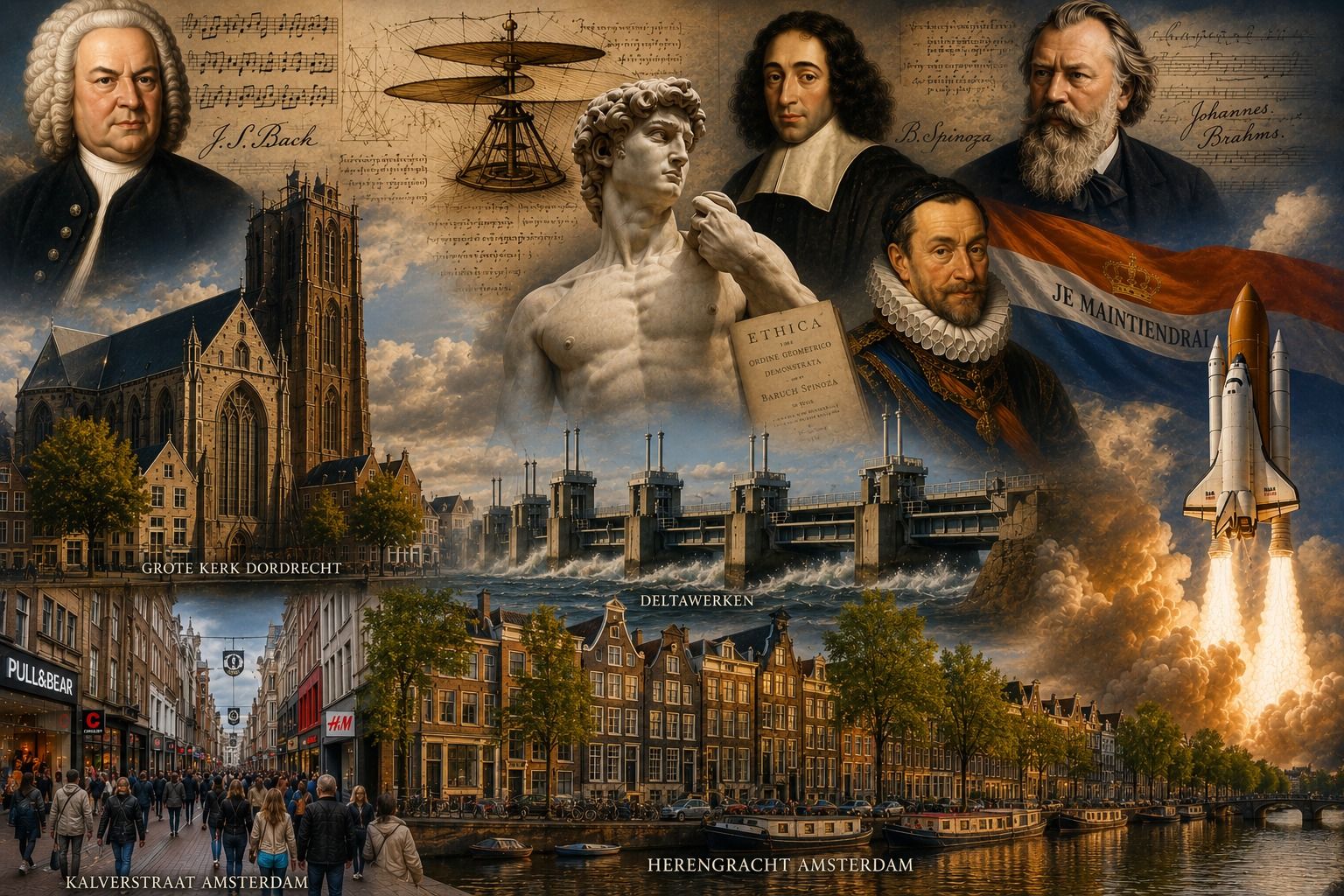
A conversation with Sid Lukkassen on decline, re-sourcing and a new future for the Netherlands
Introduction
Dr Sid Lukkassen may have left the Netherlands, but the Netherlands and the West refuse to let go of him. In What the World Can Learn from the Fall of the West , he presents a penetrating analysis of a civilisation that has traded its historical self-confidence for self-hatred.
He illustrates that self-hatred with numerous examples and demonstrates convincingly what its disastrous consequences are. Here we see Sid at his strongest. But what is his remedy?
Sid argues for a revaluation of the powerful individual who takes a critical stance towards a life dominated by self-hatred and who ruthlessly goes on the attack against it. In earlier work he drew on concepts such as the life force (conatus), the drive for recognition (thymos) and struggle (agon).
Sid clearly has a point here. The importance of these values can hardly be overstated. The only question is whether these values are sufficient for a revival of the West of old. Which values shaped the Europe we knew until recently? And does the way forward truly lie outside Europe, or rather at the front line here at home?
With these questions in mind, I enter into conversation with Sid's new book.
Sid's diagnosis: a civilisation driven by self-hatred
The core of Sid's analysis is convincing. The West has to a significant degree lost faith in its own right to exist. A culture that for centuries was characterised by vitality, self-confidence, curiosity, freedom, a drive for expansion, entrepreneurship and unprecedented prosperity now seems gripped instead by a sense of guilt and an obsessive urge for penance. Where earlier generations were marked by competition and an inexhaustible creativity, and were able to build, we today seem burdened above all with an endless compulsion to compensate.
In the Netherlands we see this reflected in debates about colonialism, national identity, immigration and a history dominated by slavery, exploitation and extreme violence. While the greatness of our past is still celebrated by Britons (Lisa Jardine, Jonathan Israel and Simon Schama) and Americans (Julia Adams, Russell Shorto and Deirdre McCloskey), we ourselves are in danger of seeing nothing but its shadow sides.
Naturally, a certain capacity for critical reflection does no harm. But when self-criticism tips over into self-hatred, it becomes pathological. A society that derives its right to exist solely from paying the interest on its historical debt is doomed.
The symptoms are everywhere. Instead of hope and optimism, we are talked into an endless sense of guilt. Drawing inspiration from an illustrious past is forbidden. The result is growing self-doubt, an unwillingness to see the point of our own reproduction, and a total inability to defend ourselves against aggressive elements from outside.
The human type that emerges in this way surrenders itself effortlessly, for the sake of its own soul's salvation, to technocratic elites. Sid sees sharply how these elites derive their legitimacy from:
the scientific underpinning of the Western guilt complex;
the ability to make us believe that penance is possible only through a system of endless redistribution of resources and power — a system bearing a strong resemblance to the late-medieval trade in indulgences; and
the pretension of moral superiority this projects over the common people, who allow themselves to be stirred up by those disgraceful populists.
The time-honoured public debate is exchanged for management. Anyone who raises fundamental questions about migration, national sovereignty or cultural identity is dismissed as a moral problem and certainly not regarded as a serious political interlocutor.
With this analysis, Sid in my view strikes at the heart of the problems we currently face.
Conatus as an answer
Against this development Sid sets a concept he introduced earlier in Wees Afgrondelijk (Amsterdam Books, 2021): conatus. Borrowed from Spinoza, the term refers to the fundamental drive of man and community to persist in their existence and to enlarge their capacities. In Sid's interpretation, conatus acquires a distinctly existential and political meaning. People must learn once again to take themselves seriously. Communities must once again develop the will to reproduce themselves. Civilisations must once again realise that they have a right to exist — regardless of whether they meet with the approval of the morally elevated Western elites.
In many respects this interpretation stands close to Nietzsche's concept of the will to power. What is central is not the will to dominate others, but the will to shape oneself, to transcend oneself and to develop one's own possibilities to the full. That makes conatus a valuable medicine against present-day thinking, which stands up only for the right of victims to exist and attributes positive value only to a civilisation capable of enforcing that right. For indeed: people are more than the sum of their traumas. They possess their own capacity to act and are able to bear responsibility both for their own choices and for the situation in which they find themselves at any given moment.
Yet here, to my mind, an important question also arises. For what happens when the human drive for self-development elevates itself to the highest norm? What happens when the will to grow is no longer bounded by an awareness of human limitation? The history of the modern age shows that not only revolutionary ideologues but also technocratic elites can be driven by an almost boundless will to bend reality to their designs. Precisely for that reason, Sid's emphasis on conatus deserves, in my conviction, to be supplemented.
Why conatus is not enough
Sid's conatus is characterised by qualities that have always been of vital importance in the European civilisational tradition: courage, a sense of honour and self-overcoming. All three are indeed indispensable as an antidote in a culture dominated by a combination of self-hatred and a cult of victimhood.
But to be creative, they must be accompanied by what the ancient Greeks called phronesis — practical wisdom — and what the Romans called prudentia: a certain measure of discipline. In this way arose the capacity to join strength with insight, ambition with self-restraint and courage with a sense of reality.
A civilisation, after all, becomes great not only by acting, but also by understanding where the limits of its action lie. Without prudence, courage turns into recklessness, self-confidence into hubris, competition into unbridled destructiveness and conatus into a will to total control.
Precisely here lies one of the deepest insights of the Christian tradition. Man possesses great capacities, but remains a fallible being. No individual, no party, no class and no ideology possesses complete knowledge of reality. The strength of European civilisation long lay precisely in the awareness that power must be bounded, that institutions must check one another and that no one may set himself up as the measure of all things.
What made the West truly unique
On this point I wish to supplement Sid further. A concept such as conatus — including its heroic associations with ancient Greek notions of struggle (agon) and the drive for recognition (thymos) — is important, but does not explain why it was the West in particular that became so exceptionally successful. Such heroics, after all, are not uniquely European. Courage we also find among the Spartans. A sense of honour we also find among the samurai. A fighting spirit we find in virtually every warrior culture in world history.
The question, therefore, is not what made Europe so vital and powerful. The question is what enabled Europe to transform its powerful impulses into a civilisation marked by unprecedented creativity, one that has yielded us freedom and prosperity without historical parallel.
Sid is right: in the face of today's decadence, our ancient impulses are due a thorough revaluation. Rather than allowing those impulses to be dismissed as 'primitive vices' — vices our 'morally superior' civilisation is supposed to have overcome — it is of vital importance to tap into them anew.
What distinguished the West from many other civilisations was its capacity to transform vital impulses and make them productive. Thus the need for competition and struggle took shape in entrepreneurship, the free-market economy and a culture of political debate. The will to distinguish oneself found a peaceful outlet in science, technological invention and intellectual rivalry. The drive for expansion became visible in trade, innovation and voyages of discovery. Even the longing to transcend the limits of one's own existence was converted into art, architecture, music and philosophy.
Europe's greatest achievement was therefore not merely the discovery of conatus as a principle and driving force, but its transformation into something that may without embarrassment be called 'formidable'.
The Christian transformation of heroic man
Here we come to an element that in Sid's work remains, to my taste, underexposed: Christianity. Not because the West was exclusively Christian. European civilisation is the fruit of the encounter between Athens, Rome and Jerusalem. But it was Christianity in particular that brought about a decisive transformation of heroic man.
Christianity did not abolish the aristocratic impulse, but placed it within a broader moral horizon. The warrior did not lose his courage, the entrepreneur his ambition, nor the ruler his decisiveness. What changed was the framework within which these qualities acquired meaning. Power had to be bounded. Freedom had to go hand in hand with responsibility. Success had to be shared in order to have a cumulative effect.
All this not from the political conviction that unity is more than the sum of its parts — although that Spartan tendency was always present in the West as well. What made the West unique was the tension-laden relationship this conviction maintained with the Jewish belief that life itself, in all its many colours, is always more than the whole. It is perhaps no coincidence, then, that it was Spinoza who coined the concept of conatus.
Man was no longer seen exclusively as a member of a particular tribe, a dynasty or a social class, but as a being with inherent dignity. That insight had far-reaching consequences. It made criticism of rulers possible, because they too were subject to a higher norm. It fostered entrepreneurship, because labour and creativity received a positive valuation. It was precisely this combination of dynamism and moral limitation that proved extraordinarily fruitful.
Cultural Marxism as a perversion of Christianity
At first sight, the emphasis the Christian tradition has always placed on the inherent dignity of the individual, and its insistence on the necessity of inclusiveness, appears to find its most pronounced echo in present-day cultural Marxism.
But it amounts to little more than fair appearance. For here we are very far removed from the original idea that we human beings are all creatures of Him who is the source of all life. Just as we are far removed from the idea that we are all equally fallible and all inclined to present ourselves as better than we are.
Caring for one's neighbour was, in the Christian tradition, always a matter of helping the other, with some support, to stand on his own two feet again and giving him a second chance. That could be done by supporting one's neighbour when he had fallen into difficulty through no fault of his own. But when it did prove to be his own fault, there was always the possibility of confession, forgiveness and new opportunities.
In the Christian tradition, concepts such as 'sin' and 'guilt' represented creative principles. Whereas in a shame culture faults and failings are denied or swept under the carpet, in a Christian guilt culture they acquire creative potential by being named as faults and failings, by calling those involved to account and, at the same time, by offering the possibility of doing better henceforth.
Of course, the Christian tradition also knew periods in which rulers, with an eye to their own gain and claims to power, arrogated to themselves the right to determine what counted as 'sin' and 'guilt', and used this to legitimise their trade in indulgences.
But time and again there were counter-movements within that same tradition which rose up against this and asserted that we were sinful and guilty first and foremost in the eyes of God. And that He Himself had already paid for our sins and guilt, and always gave us the chance to begin anew.
It was above all in the age of the Renaissance and the Reformation that this idea came to full flower. The energy it gave people was one of the most important catalysts behind the explosion of creativity and the unprecedented unfolding of human possibilities that characterised the early modern period.
By contrast, modern Christianity has turned into a cult of victimhood. Once individuals have been defined as objects of Christian love, they can lay claim to unceasing support and infinite forgiveness.
Their deeds, after all, are the result of unfortunate circumstances and not a matter of personal responsibility. Their victimhood is not a question of individual circumstances, but simply of the fact that they belong to a group that has always been exploited and discriminated against by us Westerners.
Just as the individual is invariably a victim, so we Westerners are invariably perpetrators. That it was only in the West that slavery was ever abolished is beside the point. That migrants receive opportunities here they never had in their countries of origin detracts nothing from their status as victims.
That women increasingly fall victim to violent crime at the hands of non-Western immigrants is wholly insufficient to pay off our debt to the real 'victims'. The actual victims here are no more than a meagre interest payment on a debt that can itself never be redeemed.
And with that we are back at the destructive self-hatred which, according to Sid too, the West has allowed cultural Marxism to talk it into. But let no one claim that the sense of guilt it propagates represents an authentic Christianity — on the contrary: it is its complete perversion.
Re-sourcing: back to the vital core
In an age ideologically driven by self-hatred, re-sourcing is necessary — at least, if we wish to return to a civilisation in which vitality, freedom, creativity and prosperity once again go hand in hand.
This is, of course, not about a nostalgic return to an idealised past — Greek, Roman, our own Golden Age, or even the great revival of our culture at the end of the nineteenth century.
The kind of re-sourcing that Sid too is searching for must be found in the ancient zest for life that characterised the heroes who, through trial and error and with much blood, sweat and tears, shaped our civilisation.
This primal force — Spinoza's conatus, Nietzsche's will to power — is given to every human being at the very beginning of his or her life. The way in which that primal force manifests itself is indeed characterised by the struggle for the space necessary to develop oneself, and by the hunger for recognition of one's abilities in the pursuit of one's own goals.
Everything then stands or falls, in my conviction, with the question of whether our present culture values those qualities sufficiently — not to suppress that primal force, but to support, channel and sublimate it in a positive direction.
More than any other civilisation, it was the Christian one that gave every individual the calling not only to develop his or her own talents to the full, but also to develop all the possibilities our earth offers us. At the same time, it managed to channel and sublimate the underlying energies in such a way that it produced a civilisation which never ceased to fascinate even rival civilisations.
Religion in this context was not mere consolation or, as Sid sometimes suggests, a form of 'hopium'. For centuries, Christianity functioned precisely as a powerful philosophy of life. It gave people confidence that their efforts had meaning, that reality was intelligible and that failure never had the last word.
Therein, to my conviction, lies the deepest explanation for the unprecedented creativity of the West: the combination of aristocratic self-formation, trust in a meaningful reality, room for personal responsibility and the belief that man, despite his faults and failings, can always begin anew.
A new sound, a new spring
Here Sid's idea of a new spring becomes relevant once more. One of the most valuable insights in his work is that it does not begin with election results or political power, but with the formation of character. It begins with people who refuse to be taken in by a reigning ideology of self-hatred, who will not let their zest for life be taken from them, who summon the courage to think against the current and to bear responsibility for their own freedom.
This new generation of citizens will not be able to flourish within many of the existing structures. Contributing to the public debate is one thing. But the true creative act consists in the deliberate choice of a particular kind of people with whom we enter into lasting relationships, the formation of new communities, alternative institutions, independent media — even a new societal pillar.
Perhaps therein lies the most important lesson, for the Netherlands too. A new spring does not begin with the state, but with citizens. It begins with families who invest in the upbringing of their children, entrepreneurs who take responsibility, schools that take knowledge seriously, associations that cultivate community spirit and churches that once again realise they are more than custodians of a religious heritage.
The real struggle
Must people like Sid leave the Netherlands in order to continue the struggle from outside? That is ultimately a personal choice. For some, distance may even help them to see more sharply what is going wrong in Europe.
For the Netherlands as a civilisation, however, emigration can be no answer. A civilisation is not saved from the sidelines. It is renewed by people who are prepared to take responsibility for the community in which they live.
The challenge facing the Netherlands is therefore not in the first place political, but cultural and spiritual in nature. It calls for a renewed sense of responsibility for the common house that earlier generations have built. That presupposes self-knowledge instead of self-hatred, prudence instead of utopian thinking, and a rediscovery of what Sid rightly calls conatus: the will to exist, to build and to pass on.
If we can once again recover the unique synthesis of Jewish zest for life, Greek excellence, Roman civic virtue, Christian dignity and modern enterprise, then the story of the West need not end in decline. Then, out of autumn, a new spring may yet arise.
Occasioned by: Sid Lukkassen, What the World Can Learn from the Fall of the West. Published by Academica Press, Washington, 2026; 380 pp.; $79.95 hardback, $25 paperback.

Hans van de Breevaart
Senior Researcher at the Renaissance Institute, the Think-Tank of FVD.
Senior Researcher at the Renaissance Institute, the Think-Tank of FVD.
Related articles
 Culture
The Road Home: Reflections on Christopher Nolan’s The Odyssey
 Culture
The hour has struck: Europe between self-revelation and renewal: A reflection on the root causes of the European crisis
 Culture