
Tens of thousands of Africans storm Spanish enclave Tom Russcher MP and Ralf Dekker MP table parliamentary questions
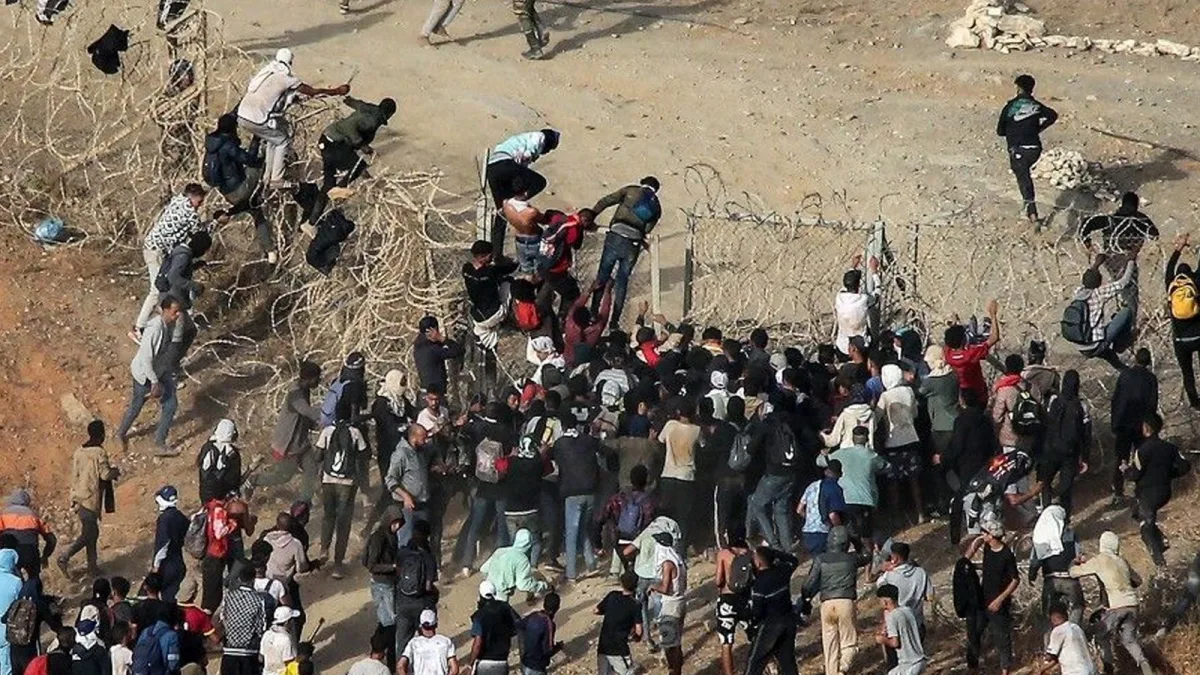
At the end of July, within 24 hours, tens of thousands of Africans stormed EU territory in the Spanish exclave of Ceuta. Moroccan and Spanish border guards stood by and watched.
This came just a few weeks after Spanish Prime Minister Sánchez allowed over a million illegal immigrants to apply for residence permits and after the Spanish Supreme Court ruled that intruders arriving by sea could not be immediately deported. Once again, it is clear that measures facilitating migration act as a magnet.
With a Spanish residence permit, these intruders will soon be able to travel freely throughout the Schengen area. After five years, they will be allowed to settle permanently in the Netherlands. And as soon as Spain naturalises them, they will become EU citizens to whom we can never refuse entry again.
These people have no business being on our continent. The only way to prevent them all from travelling on to the Netherlands is to regain control of our borders and scrap Schengen, the European Convention on Human Rights and the UN Refugee Convention.
Tom Russcher and Ralf Dekker tabled parliamentary questions.
Questions from Mr Russcher (FVD) and Mr Dekker (FVD) to the Minister for Asylum and Migration and the Minister for Foreign Affairs regarding the mass storming of the Spanish exclaves of Ceuta and Melilla and the consequences thereof for the Netherlands.
Question 1. Are you aware of reports that, according to estimates by the Spanish Ministry of the Interior, approximately 49,000 migrants from Morocco entered the Spanish exclave of Ceuta within 24 hours, both by land and by sea?
Question 2. Do you share the view that the border of Ceuta is not merely a Spanish matter, but a common external border of the European Union and the Schengen Area, the breach of which has direct consequences for the Netherlands?
Question 3. Do you acknowledge that migrants regard Ceuta as a gateway to the European Union and that a significant proportion of them will attempt to travel on to north-western European Member States, including the Netherlands?
Question 4. In your view, what lessons has the European Union learnt from the storming of the Spanish exclave of Melilla in June 2022 and Ceuta in May 2021, during which thousands of migrants also entered?
Question 5. How do you assess reports that Moroccan border guards suddenly disappeared from their posts shortly before the mass crossing?
Question 6. Do you agree with the analysis that Morocco is deliberately using migration as a means of exerting diplomatic pressure on Spain and the European Union?
Question 7. Are you prepared, either bilaterally or within the EU framework, to impose consequences for this Moroccan action, for example in the areas of visa issuance, trade preferences or development cooperation?
Question 8. Are you aware of the ruling by the Spanish Supreme Court in early July 2026, which held that migrants reaching Ceuta by swimming or by boat may not be returned without due process?
Question 9. How do you assess the fact that, according to the Spanish government, human trafficking gangs are exploiting this ruling to organise the current mass crossings?
Question 10. Do you acknowledge that this has once again demonstrated that legal safeguards preventing deportation without due process act as a magnet for illegal migration?
Question 11. Are you familiar with the judgment in N.D. and N.T. v. Spain, in which the European Court of Human Rights ruled that Spain was permitted immediately to return migrants who stormed the border fence at Melilla en masse, without thereby violating the prohibition on collective expulsion?
Question 12. Are you prepared to advocate at European level that Member States make maximum use of the scope provided by this judgment for the immediate return of migrants who storm the external border en masse?
Question 13. Are you familiar with the Sánchez government’s extraordinary regularisation scheme, under which migrants residing illegally in Spain were able to apply for a residence and work permit between 16 April and 30 June 2026, and for which, according to statements by the Spanish government, well over one million applications have been submitted?
Question 14. Are you also aware of the ‘Plan for Integration and Citizenship 2026-2030’ presented by Prime Minister Sánchez on 30 June 2026, in which this mass regularisation is explicitly presented as the first step towards full citizenship?
Question 15. In your view, what does the current explosive influx towards Ceuta, which follows shortly after the completion of the Spanish regularisation round and the presentation of the aforementioned plan, say about the pull factor of such relaxations?
Question 16. If you are of the opinion that there is no link between Spain’s regularisation policy and the current influx, can you substantiate that view with an alternative explanation for the fact that, at this very moment, tens of thousands of Moroccans are attempting to cross into Spanish territory?
Question 17. Do you acknowledge that a residence permit issued by Spain entitles the holder to travel freely throughout the Schengen area, and therefore also through the Netherlands?
Question 18. Do you acknowledge that regularised migrants, after five years of legal residence in Spain, can obtain long-term resident status, which, subject to certain conditions, entitles them to settle in other Member States, including the Netherlands?
Question 19. Do you therefore agree with the conclusion that Spain’s regularisation and naturalisation policy is, as a result, de facto part of Dutch migration policy, without the States General or the Dutch electorate having had any say in the matter?
Question 20. Are you aware of the report that Italy has threatened to temporarily exclude Spain from the Schengen Area because of this crisis, and do you share the underlying concern that migrants admitted via Spain could then spread unhindered throughout the Schengen Area?6
Question 21. Are you prepared, in light of this crisis, to step up controls at the Dutch national border?
Question 22. Can you rule out the possibility that, under the solidarity mechanism of the Asylum and Migration Management Regulation which came into force on 12 June 2026, the Netherlands will be obliged, as a result of this crisis, to take in asylum seekers from Spain or to make financial solidarity contributions?
Question 23. If the answer to question 25 is in the negative, can you indicate how many asylum seekers the Netherlands would have to take in, or what financial contributions it would have to make, in the worst-case scenario?
Question 24. Do you share the view that the deployment of just sixty Spanish military personnel in the face of an influx of tens of thousands of migrants is wholly inadequate to defend this external border of the European Union?2
Question 25. Has the Dutch Government offered Spain personnel or material support for the surveillance of the external border at Ceuta?
Question 26. If the answer to question 28 is in the negative, are you prepared, in consultation with the Minister of Defence, to make such an offer after all?
Question 27. Are you prepared to place this crisis and the cross-border consequences of Spain’s regularisation and naturalisation policy on the agenda for the next JHA Council and to inform the House of Representatives of the outcome?
Question 28. Can you answer these questions separately and as soon as possible?

Forum for Democracy
Dutch Political Party
Dutch Political Party
Related articles
 Politics
Is a reduction in gas tax impossible due to a European agreement, or are there more hidden rules at play?
 Politics
Blurring the line between alleged extremism and legitimate viewpoints threatens to narrow public debate
 Politics