
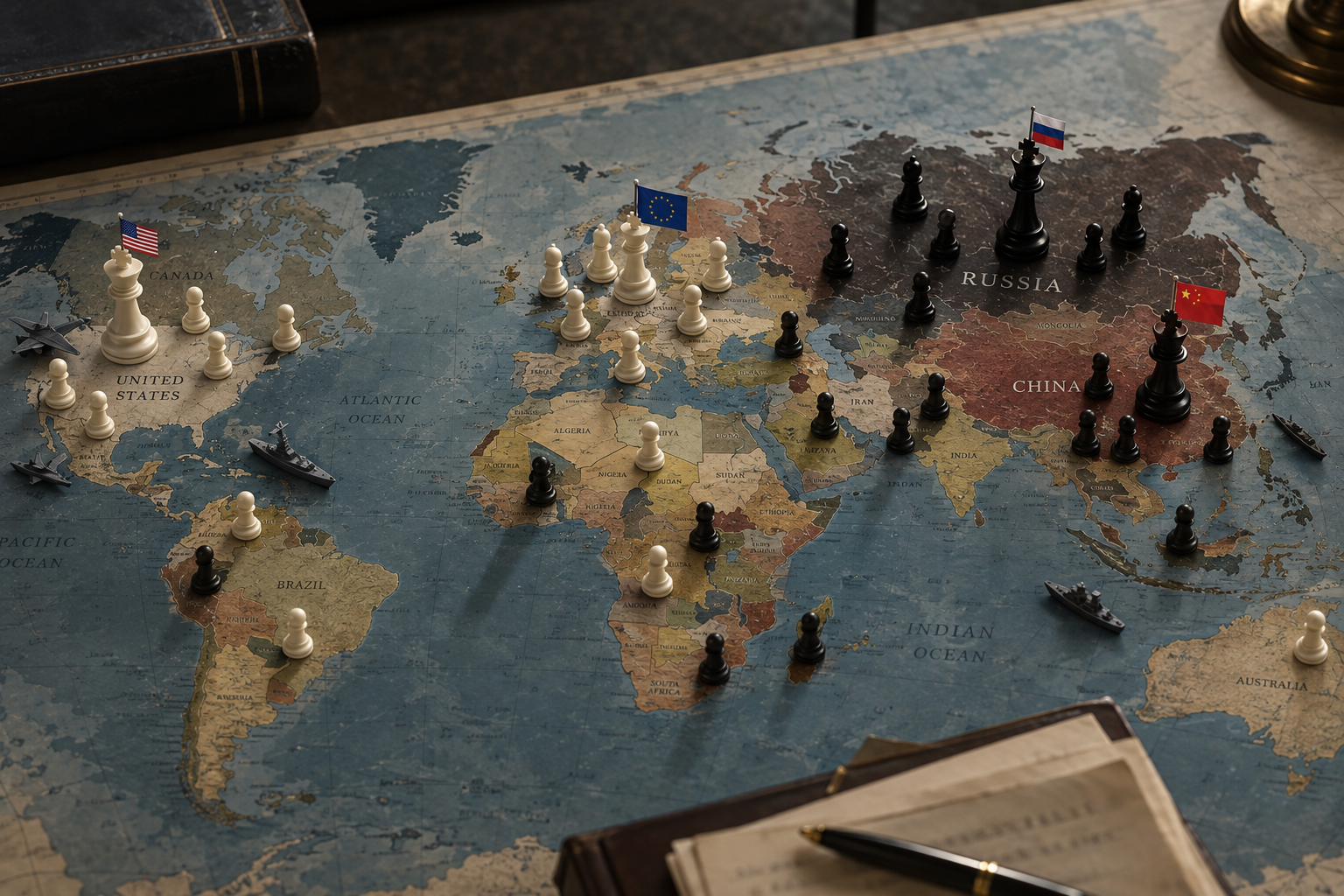
Some of you may have seen the remarkable conversation a few days ago between Tucker Carlson and the former British minister Jacob Rees-Mogg. On the surface, it was about Russia, the war in Ukraine and why, in Rees-Mogg’s view, Britain should prepare for the possibility of war. But as it went on, it turned into something far more fundamental - a debate about the role morality should play in foreign policy, and about the point at which morality turns into moralism.
The contrast was sharpest when they spoke about the Second World War. Rees-Mogg called it the classic struggle between good and evil. Carlson asked a quite different question. What had the war cost Britain? The debt, the loss of power, the end of the Empire. Had Britain really come out of it stronger or better off? Rees-Mogg’s answer was essentially very simple: Britain had done the right thing.
That exchange comes down to one basic question: what happens in foreign policy when moral certainty takes the place of analysing reality? If we stop asking what interests states pursue, what consequences our own actions have and how the other side perceives our decisions, and ask only who is on the right side and who is on the wrong one, we have left the field of geopolitical analysis.
The opponent is then judged less by the interests he pursues than by the moral character we attribute to him.
I am not arguing against morality in foreign policy. Quite the opposite. A foreign policy without moral limits would be little more than the ruthless use of power. So morality is necessary. But morality and moralism are not the same thing.
Morality sets limits on our own behaviour as well as on that of others. Moralism begins when the conviction that we are on the morally right side leads us to assume that our interests are automatically legitimate and our opponent’s are illegitimate by definition.
In geopolitics, this distinction is crucial. States act under the pressures of power, geography, history, economic dependence, military capability and perceived threat. Their interests can collide. A responsible foreign policy must therefore do more than pass moral judgement on an action. It must be able to explain why a state acts, what it wants to achieve, how it may react to our own behaviour and what may follow.
Explaining the opponent is not the same as justifying him. It is the precondition for dealing with him politically at all. Trying to understand why Russia sees a certain development as a threat is not to excuse a Russian war. Analysing why China treats Taiwan as a strategic question does not endorse a Chinese attack.
Explanation and justification are two fundamentally different things. Anyone who confuses them destroys the basis of serious geopolitical analysis.
Moralism does exactly that. It turns an opponent whose interests clash with ours into evil itself. Interests can be negotiated; security guarantees can be agreed; compromises can be reached. Absolute evil, however, cannot be bargained with. It is something you try to defeat.
That is why dividing geopolitical conflicts into good and evil is far from harmless. It reduces complex power relations to a crude moral formula and narrows the room for political manoeuvre. Diplomacy becomes suspect, compromise becomes appeasement, and any attempt to understand the other side is recast as sympathy for it.
Rees-Mogg’s description of the Second World War as the classic struggle between good and evil is a particularly useful example. We can, of course, pass moral judgement on the National Socialist regime. But if we want to understand why Europe went to war, good and evil alone will not get us far. We then have to talk about Versailles, German revisionism, French and British security interests, the conflicts of Eastern Europe, the Soviet Union and the gradual collapse of Europe’s inter-war order. All of that disappears once history is reduced to a moral tale. Or shall I say fairy tale? Moral judgement can add to historical interpretation, but it can never replace geopolitical explanation.
Hiroshima makes the problem even clearer. Rees-Mogg defended the atomic bomb essentially on the grounds that it shortened the war and saved lives overall. A similar argument is often made about the strategic bombing of German cities, Dresden in particular. The civilians who actually died are weighed against a hypothetical number who might have perished had the war gone on. A real moral and human catastrophe is thus justified by an event that never happened and whose consequences can never be known.
Here we see a peculiar moral asymmetry. When the opponent kills civilians, it proves his moral depravity. When our side kills civilians, the talk quickly turns to military necessity, proportionality and lives supposedly saved. Our actions are explained by our motives; theirs are condemned by their consequences. Our violence becomes tragic but unavoidable; the enemy’s becomes an expression of his character. So moralism lies not simply in using moral categories, but above all in applying them selectively.
We find the same pattern far beyond the battlefield. Our rearmament is deterrence; theirs is aggression. Our alliances create stability; theirs threaten the international order. Our influence supports democracy and civil society; theirs is interference or subversion. Our intelligence services protect the nation; theirs wage hybrid warfare. At some point a society can hardly recognise the geopolitical interests behind its own policy anymore, because they have been translated entirely into moral language.
The principle of territorial integrity shows this particularly well. It is, of course, a cornerstone of the international order. But no one can seriously claim that states defend it with equal vigour everywhere. Some border violations mobilise enormous economic, diplomatic and military resources; others quickly fade from political memory. The difference clearly lies not in morality, but in how geopolitically important the conflict is.
Ukraine is an especially clear case. It lies at one of Europe’s key strategic crossroads, between Russia, Central Europe and the Black Sea, and it has vast agricultural resources and significant mineral wealth. Its political and military orientation is therefore vital for Russia. It matters strategically to the United States and NATO as well. Poland links the wider Central and Eastern European space to its own ambitions for regional leadership, while also Britain seeks to extend its influence within the transatlantic security architecture and in Eastern Europe.
It would be unrealistic to imagine that all these actors care about Ukraine solely out of concern for an abstract principle of territorial integrity or for its well-being. That does not make the principle wrong. But it does mean that moral and geopolitical motives overlap, and that interests should be acknowledged as such.
And this is where moralistic thinking becomes especially dangerous for diplomacy. If we no longer see the opponent as a state with its own interests, fears and sense of security, but only as a morally illegitimate actor, moralism not only clouds our view of reality; it gradually removes the very tools with which international conflicts can be contained peacefully.
This brings us to the question: how is this conflict actually developing?
The geopolitical history of the war in Ukraine does not begin on 24 February 2022. But on that day Russia invaded Ukraine and violated the territorial integrity of a sovereign state, and that marks the beginning of the war, not the origins of the conflict.
The European security order after the Cold War rested on two principles that increasingly came into tension with one another: states should be free to choose their alliances, but no state should strengthen its security at the expense of another.
The idea that the military orientation of a directly neighbouring state could be irrelevant to a great power runs against every historical experience. The United States itself demonstrated during the Cuban Missile Crisis that it would not regard military structures of a rival power on its doorstep as a neutral exercise of sovereignty. And Russia applied the same basic logic of great-power security interests to Ukraine.
This relationship was already reflected in the Russian-Ukrainian Friendship Treaty of 1997. It recognised territorial integrity and the inviolability of borders but also committed both sides not to support arrangements directed against the other or allow their territory to be used in ways harmful to the other’s security. Russia had no general veto over Ukrainian foreign policy, but the treaty clearly treated the security of both states as interconnected.
In 2008, NATO declared at Bucharest that Ukraine and Georgia would become members of the Alliance, making future Ukrainian membership an explicit political objective.
The events of 2013 and 2014 sharpened this conflict dramatically. Ukraine was deeply divided over its strategic direction. The Maidan was a domestic protest movement but Western involvement was also real, as the well-known conversation between Victoria Nuland and Geoffrey Pyatt demonstrated. After Viktor Yanukovych was removed from power, the geopolitical result was clear: Russia lost substantial influence, while Ukraine moved increasingly towards the West. The questions remains: Qui bono?
The annexation of Crimea, the war in the Donbas and the Minsk agreements followed. Minsk combined military measures with political provisions on elections, special status, decentralisation and the later restoration of Ukrainian control over the border, but the settlement was never fully implemented. Russia violated commitments, while political steps envisaged on the Ukrainian side also remained unfulfilled. Later Western statements that Minsk had bought Ukraine time to strengthen its military could only reinforce Moscow’s suspicion that diplomacy was being used tactically within a wider geopolitical struggle.
None of this justifies Russia’s decision to launch the attack in 2022. But it does show why the conflict cannot be understood as though an intact European peace order had suddenly been destroyed without any prior history by an irrationally expansionist Russia.
After more than four and a half years of war, neither side has reached its maximum goals. Russia has neither brought Ukraine under political control nor defeated it decisively on the battlefield. Ukraine, despite massive Western support, has not been able to drive Russia out of all the territory Moscow controls. Yet the war is not shrinking. It is reaching ever deeper into the strategic hinterland of both countries. Russia is striking Ukrainian energy systems, infrastructure and defence industry with waves of missiles and drones. Ukraine is hitting Russian refineries, airfields, power facilities and, increasingly, digital networks far behind the front.
This expansion is especially dangerous. From Moscow’s point of view, strikes deep inside internationally recognised Russian territory increasingly touch on territorial integrity and core state security. The further the war is carried into strategic depth, the closer it comes to the threshold where conventional warfare and nuclear deterrence begin to overlap. Then there is the question of how far Western intelligence, finance, technology or weapons make such operations possible.
The more Moscow sees attacks on Russian soil not just as Ukrainian actions but as part of a Western-backed war effort, the greater the risk that the Kremlin redefines the conflict as a direct confrontation with NATO rather than a war against Ukraine. At the same time, however, escalatory language is not confined to Moscow. Senior NATO military figures have themselves discussed the possibility of pre-emptive strikes in response to Russian hybrid warfare.
Kaliningrad shows that this nuclear dimension is no longer merely theoretical. In July 2025, General Christopher Donahue, then commander of US Army Europe and Africa, said publicly that Kaliningrad was surrounded by NATO territory and that the Alliance could now neutralise the Russian A2/AD zone there from the ground faster than ever before. A2/AD mean anti access and area denial zone — its network of missiles, air defences and other systems designed to restrict NATO access to this region. Particularly striking was his remark that this capability had already been planned and developed. In recent days Russia has explicitly warned that isolating or threatening Kaliningrad militarily could lead directly to escalation, up to the nuclear level.
In all of this, we should not forget that Kaliningrad already forms part of Russia’s nuclear posture. The region hosts nuclear-capable systems and modernised nuclear storage facilities. Against that background, public discussion by senior NATO military figures about neutralising Russian military capabilities there cannot be treated as strategically neutral language. From Moscow’s perspective, such statements inevitably touch upon one of the most sensitive elements of Russian deterrence and are therefore bound to be perceived as highly provocative.
The military stalemate along much of the front therefore does not bring political relief. Quite the opposite. The war’s geographical and technological reach is growing, and at the same time the West is undergoing a structural shift that goes far beyond supporting Ukraine. Europe is increasingly gearing its military planning to a long confrontation with Russia. Germany speaks openly of becoming fit for war, Britain of preparing the whole of society for that possibility. German and British military leaders increasingly justify European rearmament in explicitly moral terms. Meanwhile, large parts of Western security policy no longer treat Russia mainly as a rival that might one day belong to a wider European order. They treat it as a permanently revisionist adversary to be deterred militarily, weakened economically and contained strategically.
In recent days I have seen for myself how deeply this thinking has entered public debate. At an event of the Worshipful Company of Glovers here in London, a British general spoke at length about Ukraine. What struck me most was the absolute certainty of his presentation. Russia appeared as the sole cause of the entire security crisis and as a permanent threat to be met with military force. Support for Ukraine was presented as almost self-evident. I would add that, as a politician and a geopolitical analyst, I found it highly inappropriate to use such an occasion for what was in effect political propaganda.
Poland shows the military side of this development particularly clearly. Warsaw is building what is meant to become Europe’s largest land army. It already has more than 220,000 personnel in its armed forces and spends an exceptionally high share of its economic output on defence. At the same time, it is creating large industrial capacity for ammunition, drones, air defence and other key areas. Poland is thus becoming the military centre of gravity of Central and Eastern Europe, and it links this to a clear ambition for regional leadership between the Baltic and the Black Sea. A Ukraine permanently anchored in the West is strategically important to such an order.
Germany, too, is fundamentally changing its role. It is no longer merely supplying weapons from existing stocks, but financing Ukraine’s defence on a multi-billion-euro scale and becoming increasingly integrated into its defence-industrial structure. At the beginning of October, a further one billion euros in military aid was announced alongside new German-Ukrainian agreements on air defence, radar and drone systems.
At the same time, Berlin is significantly expanding its own military posture and stationing a full heavy combat brigade permanently in Lithuania. By the end of 2027, around 4,800 soldiers and some 200 civilian staff are due to be based there, with the brigade fully operational. The United States has also maintained a rotating armoured presence in Lithuania for years and after a break they send to heavy battalions into the country.
The conflict is also no longer confined to the land front or to bilateral military aid. The Black Sea is increasingly becoming an arena of escalation on its own. On 8 October, Turkish Foreign Minister Hakan Fidan explicitly warned that both Russia and Ukraine were expanding their military operations there, endangering shipping and, increasingly, civilian merchant vessels as well. Only a few days earlier, a cargo ship sank after a drone attack in Bulgaria’s exclusive economic zone; it was initially unclear who was responsible.
Meanwhile, economic and industrial support for Ukraine is becoming steadily institutionalised. On 7 October, the European Commission paid out a further 1.24 billion euros directly for drones, interceptor drones, loitering munitions and missiles made in Ukraine.
This is part of a 90-billion-euro support package for 2026 and 2027, of which around 60 billion is earmarked for military purposes. In 2026 alone, 28.3 billion euros is to go to Ukraine’s defence industry.
In parallel, on 8 October Britain increased economic pressure on Russia with new sanctions against 38 individuals and companies involved in oil trading, financial services, arms production and sanctions evasion.
Lithuania is now going a step further. Its government has declared itself willing to pay for a permanent American garrison. It is in this context that the debate over Article 137 of the Lithuanian constitution takes on strategic weight. The article currently bans both weapons of mass destruction and foreign military bases on Lithuanian soil. On 6 October, parliament voted, in a first constitutional reading, to remove that restriction. By removing this restriction, Lithuania would deliberately eliminate the constitutional barrier that has until now prohibited foreign military bases and weapons of mass destruction on its territory, thereby opening options that the constitution has so far explicitly excluded. To do this in such a tense geopolitical environment speaks volumes about the direction in which security policy is moving.
In my view, it would also be a mistake to look at these developments in isolation. Taken together, the permanent infrastructure supporting American forces, the German brigade, Poland’s military expansion, closer military-industrial integration with Ukraine, Lithuania’s wish for a permanent American presence and the proposed removal of constitutional restrictions on foreign bases and weapons of mass destruction amount to a clear military concentration across the space between the Baltic Sea, Poland, the Baltic states, Belarus, Kaliningrad and Russia. None of these measures on its own might proves preparation for a war of aggression, but their combined strategic effect cannot be ignored.
In the West, each step is presented as defensive. Yet geopolitical analysis cannot stop at our own explanation of our actions. Seen from Moscow, an ever-denser military zone is emerging along Russia’s western approaches. Russia will inevitably respond according to what it regards as its own strategic and territorial interests. This is the classic security dilemma: one side’s defensive reaction becomes the other side’s evidence of threat, which then justifies the next countermeasure.
The current American-Russian talks about Nord Stream and other energy projects should not be mistaken for political détente. They show instead that hard economic interests continue to be pursued even in the midst of geopolitical confrontation. American investors are examining stakes in Russian energy assets while sanctions and security questions remain unresolved. It is a reminder that great-power politics combines economic interests with political and military ones.
The drone incident at Leipzig/Halle airport you might heard about also shows how dangerous rapid attribution can become in such a tense climate. In early August, a drone carrying explosives was found there, and on 1 September the German government publicly blamed Russia, citing police and intelligence findings. Political consequences followed, although the full evidential chain has not been made public. The issue is not to declare Russia innocent, but to ask what standard of evidence should be required before suspicion becomes an official accusation and that accusation leads to interstate countermeasures.
Alongside all the developments already mentioned, Russia’s actual military capabilities must also be assessed soberly.
For more than four years it has required enormous material, manpower and logistical resources to wage a war directly on its own border, while territorial gains have remained limited in relation to the effort and losses involved. This does not make Russia militarily harmless, but it does call into question the frequently repeated idea that Russian forces could simply move from Ukraine through Poland or the Baltic states and deep into Europe.
Interestingly, that may make a direct NATO-Russia confrontation more dangerous rather than less. NATO possesses far greater economic and military resources overall. If Moscow concluded in an open conflict that it faced decisive military defeat or an existential threat to the Russian state, nuclear deterrence would inevitably assume greater importance. As the war increasingly reaches Russian territory and Western military structures move closer to Russia, the conventional war in Ukraine and the strategic deterrence relationship between NATO and Russia are beginning to merge. And Russia does not imagine defeat in the way some Western politicians, seem to picture it. if its leadership came to believe it was facing collapse, the risk of nuclear escalation would rise dramatically.
If NATO and Russia stay on their present course, the logical result is not détente but an increasingly direct confrontation. That does not mean a major European war is inevitable. But the risk grows with every additional military capability, every shortening of decision times, every new incident and every political step that narrows the room for future compromise. No government even has to decide deliberately to launch one. Under such conditions, a wrongly attributed act of sabotage, a misunderstood drone flight, an attack on military infrastructure may be enough to set off an escalation chain that becomes extremely hard to control.
And this is where we return to the first part of my remarks. Moralism makes it harder to recognise escalation as a reciprocal process, because each side tends to interpret its own actions more favourably than those of its opponent.
A responsible foreign policy must be able to hold several thoughts at once. It must be possible to criticise Russian decisions without concluding that Russia has no legitimate security interests at all. It must be possible to recognise Ukrainian sovereignty while understanding that Ukraine’s strategic orientation has consequences for Russia. It must be possible to protect NATO states while asking how far military concentration can go before deterrence itself becomes part of the escalation.
Diplomacy does not mean trusting the other side. It means arranging conflicting interests in such a way that states which distrust one another still do not end up at war. Deterrence remains necessary, but deterrence without a political way out ultimately produces permanent confrontation. And between nuclear powers, that is not a bright idea at all.
That is why I find Jacob Rees-Mogg’s formula of a classic struggle between good and evil so problematic. Not because these opposites do not exist, nor because we should give up moral standards, but because they alone are not enough to understand geopolitical reality.
For that reason, moral standards must be universal. If territorial integrity is a principle, it cannot matter only where defending it suits our interests. If non-interference is a principle, it cannot apply only to our opponents. If treaties are binding, we must take our own obligations seriously too. And if killing innocent people is morally wrong, the nationality of the pilot does not change the moral character of the bomb.
Morality therefore requires self-restraint and a willingness to examine our own conduct, whereas moralism offers the comforting certainty that our actions are legitimate simply because we believe our cause to be right. A moral geopolitics must demand more than good intentions, because good intentions do not guarantee good outcomes. We must distinguish between understanding an opponent and justifying him, between deterrence and escalation, between territorial law and geopolitical reality, and between military strength and political wisdom. Above all, we must distinguish between victory and peace, because the two are by no means the same.
A missile does not care which side has the more convincing moral narrative, and a nuclear weapon knows neither good nor evil. Geography does not vanish because we prefer to read it as a question of right and wrong. So we need to return to reality: not instead of morality, but precisely out of moral responsibility. We need to talk to each other again as equals. Anyone who wants to preserve peace must do more than believe in the rightness of his cause. He must understand how wars begin, how escalation spirals develop and at what point his own policy may itself become part of the problem.
Only with that degree of self-awareness can we keep this conflict from escalating further and protect our Europe from the consequences of a wider war. We owe that to the generations that will come after us and to the cultural heritage that such a development would inevitably place at risk.
This is the text of a speech given at the Traditional Britain Group conference held in London in October 2026

Stefan Korte
Stefan Korte is a foreign policy adviser who worked with Bundestag members from the AfD.
Stefan Korte is a foreign policy adviser who for many years worked in the Bundestag as an adviser to Bundestag members from the AfD (Alternative für Deutschland).
Related articles
 Opinion
The Pillar, Cofnas, Ghent – the battle for the institutions
 Opinion
Who sustains our shared world? Part 2: Hannah Arendt and Frits Bolkestein on plurality, freedom and citizenship
 Opinion