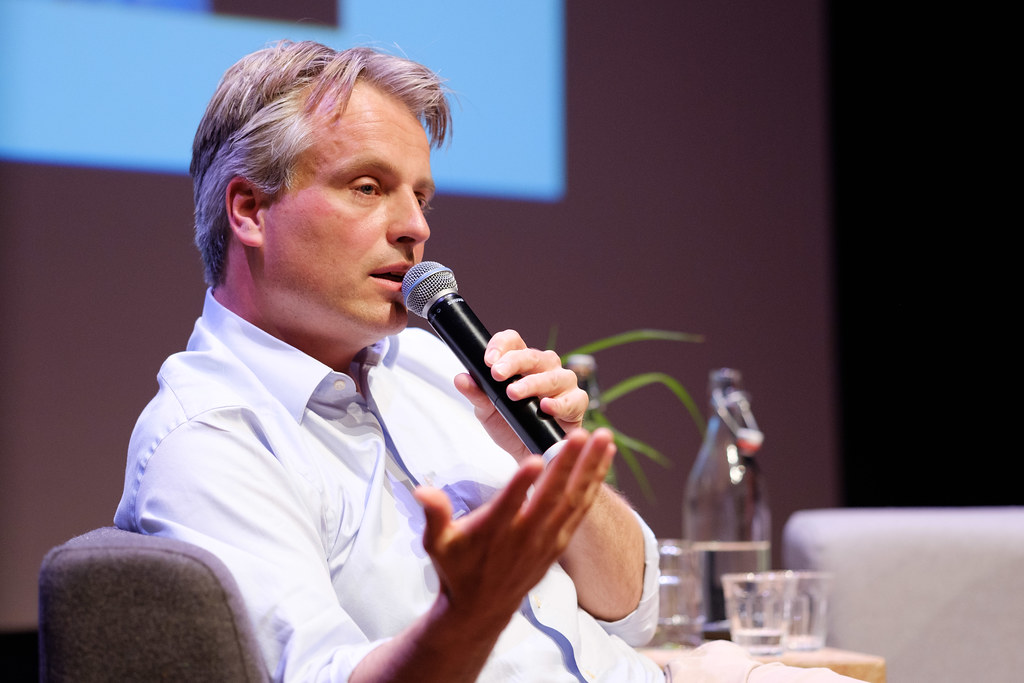
Joris Luyendijk is a former journalist who has become an activist for Ukraine. He recently abandoned what he said had been his earlier journalistic neutrality now to campaign and raise funds for both humanitarian and military causes (the purchase of drones) in that country. He gave a long interview recently to Tim Hofman of BOOS, a publicly funded Youtube channel in the Netherlands.
Luyendijk is highly articulate, especially when set against this particular interviewer. He is convinced that Europe is now on its own; that Europeans made a huge mistake trusting the Americans; that Europe is in extreme danger from an aggressive Russia; and that it is imperative now that Europeans spend more on their own defence and security.
He claims in the interview that Europe and the Netherlands are under ‘daily attack’ from Russia; that if Ukraine falls, Europe will be next; that ‘we need a clenched fist’ to defend ourselves; that Russia launched the war ‘to destroy the Ukrainian language and culture’; and that social media which, he says, are manipulated by algorithms, are destroying democracy. ‘Democracy cannot survive with social media.’
Luyendijk describes himself a ‘highly gifted’ and has spoken of his high intelligence as a source of anxiety and isolation. ‘Vulnerability’ is a theme which comes up both in the interview about himself and in the podcast discussion about Ukraine. This sense of vulnerability no doubt explains his obsession with its supposed remedy, ‘security’. Twice Luyendijk said that Ukraine is the house next door which is on fire and which risks causing our own house to burn down.
‘Security’ of course includes the security services, with whom Luyendijk admits he is in regular contact. He tells us that he goes for walks in the woods with secret service agents from the Netherlands and other NATO countries, or from NATO itself, leaving his phone behind in the car. He even boasts that he ‘can be a voice’ for those security services who cannot themselves speak to the media directly – in other words that he is relaying their message. Elsewhere this avowed leftist and progressive, who says that LGBT is one of the most important causes for which he stands – he conflates it with the ‘democracy’ which he repeatedly says is under attack - says, ‘I stand on the barricades with the Dutch armaments industry.’
Luyendijk’s claims and statements come thick and fast and leave the poor interviewer with his high-pitched voice stumbling for words. But the interview is largely fact-free, or at least evidence free. So, for instance, Luyendijk repeats as fact an unproven claim that Russia was somehow behind anti-Jewish graffiti daubed on Paris synagogues and other Jewish sites in 2023 and 2024, an assertion made very freely at the time but for which there is no evidence. The claim is instead based on the ridiculous assumption that anti-Israeli feeling during the Gaza operation can only have been stoked by a malevolent foreign power. This in turn assumes, very sinisterly, that any ‘division’ in society – any difference of opinion - is the result of foreign manipulation, a distinctly undemocratic idea often peddled by today’s ‘democrats’.
Similarly, Luyendijk gives no example of the ‘daily cyber attacks’ which Russia is apparently directing at Europe, still less for his claim that Russia’s war aim is to destroy the Ukrainian language. If Russia is conducting cyber-attacks, what is their goal and what are their targets? And what about Western cyber-attacks or counter-attacks against Russia? Are we conducting any and, if not, why not? We are left with nothing but this vague allusion to these virtual ‘attacks’ for which we have no evidence or illustration.
The fact-free reasoning is crucial for the lucidity of the cause. Luyendijk’s blazing moral clarity brooks no counter-example and seems not to observe the law of non-contradiction. So, for instance, if as he says Russia is currently losing 30,000 men every month – a farcical claim for which there is also no evidence – and when she is struggling to capture a few villages in Donetsk, then how can her armies possibly move beyond the Donbass, through Kiev and the rest of Ukraine (well over 1,000 km wide), across Poland and Germany and into the Netherlands? It is not possible to believe such fairy tales, especially when you simultaneously claim that Ukraine is ‘turning the tide’.
Similarly, Luyendijk sees himself as combatting the ‘extreme right’ but does not seem to know or care about the role of the Azov corps in the Ukrainian armed forces – they seem to be the only part of the army which actually fights - or of the recent reburial ceremonies conducted in Ukraine for various extreme right Ukrainian nationalist figures who collaborated with Hitler. This is schizophrenic.
Absent from the interview is any sense of nuance. Indeed Luyendijk does everything to banish it. His vision is apocalyptic – them or us, the burning house, the clenched fist. Trump, Putin and Xi are often elided as if they were simply different iterations of the same ubiquitous danger. ‘Security’ is somehow also an absolute, as if it, like danger, were not also a matter of degree and calibration. Ukraine is a pure victim – Luyendijk mentions his aid to ‘pregnant women’ at least twice. His stated ‘vulnerability’ often slips into passive-aggression against his interviewer – ‘Why did you not rebel earlier?’, ‘Why do you not do what I am doing?’
So naturally there is not talk of peace, only war. No talk of negotiations, just struggle. No assessment of the causes of the war, no mention of the events in the period 2014-2022, just a maniac Russian president – it is always ‘Putin’, never ‘Russia’ – determined to carry out genocide. There is no mention of US biolabs in Ukraine nor of CIA listening stations there; no mention of the military agreements signed with Britain and the USA in 2021 which aimed to reconquer Crimea and the Donbass by force. There is no engagement with the serious and authoritative voices, mainly in America, calling for a peace deal. There is no assessment of the military reality on the ground.
Luyendijk reminds me of Anne Applebaum, Melanie Philips and Timothy Snyder, the last two former leftists, like Luyendijk, the first a new arrival to the left-liberal camp having, like her husband, originally frequented the nationalist Right. Anne Applebaum insists that the world is divided between authoritarians and democrats and that authoritarianism appeals to those who do not like, or cannot deal with, complexity - in other words, to stupid people. Yet the boot is on the other foot: it is she who reduces the world to a simplistic binary category. Philips and Snyder are even crazier, Philips always raising the binary choice to its acutest degree possible: the whole of Western civilisation, for instance, is based on Judaism, according to Philips, and Western anti-Semitism will therefore destroy its very foundations.
Listening to Luyendijk and these others, I am reminded of an often-quoted remark by G. K. Chesterton.
“If you argue with a madman, it is extremely probable that you will get the worst of it; for in many ways his mind moves all the quicker for not being delayed by things that go with good judgment. He is not hampered by a sense of humour or by clarity, or by the dumb certainties of experience. He is the more logical for losing certain sane affections. Indeed, the common phrase for insanity is in this respect a misleading one. The madman is not the man who has lost his reason. The madman is the man who has lost everything except his reason.”
Luyendijk occupies his own universe. He says of himself that he is trapped inside his own giftedness, isolated from the world because of it. His devotion to the Ukrainian cause, which he claims is also a fight for European security, is surely a product of his deep psychological need for ‘security’ which, he believes, can come only from brute force and the readiness to use it. The clenched fist is the opposite of the open mind and obviously also of the outstretched hand. He has adopted someone else’s cause – and explicitly abandoned his earlier so-called neutrality to do so – in order to escape from his own isolation and to give his life a sense of meaning. Warmongering and scaremongering have become a form of therapy.
Is he being manipulated? The security services he venerates are primarily concerned with the manipulation and control of public opinion – ‘psyops’. This is why the CIA was set up in 1947, this is the primary activity of other security services today. Luyendijk’s concern that social media must be brought under control is but a repetition of one of those services’ biggest concerns – that they are losing control of the narrative. He himself says he is ‘more effective’ as a propagandist and an activist than as an active military serviceman, thereby echoing the head of the British army who said in 2018 that the war of words is more important than the war of weapons. Fear tactics such as those deployed during Covid are quite explicitly part of the security state’s toolbox, together with the ‘nudge’ and other forms of behavioural science. Luyendijk is determined to make people afraid so that they rush to the state, and particularly to its security services, for safety – which is just what those security services want.
Modern societies, as Patrick Deneen has famously shown, promote social isolation because liberalism seeks to liberate the individual from any unchosen determinism like the family or the nation. The individual is king but terribly alone. Liberalism thereby enters a doom loop, along the Hobbesian model where the war of all against all leaves all of us vulnerable, because the only cure for this insecurity, isolation and solitude is the state. As Tocqueville foresaw, liberalism therefore promotes the very growth of state power which it initially hoped to prevent – ‘the immense and tutelary power which takes upon itself alone the task of securing people’s gratifications and watching over their fate’. If nothing else, Luyendijk’s escape from his personal sense of isolation into the warm certainties of someone else’s war, and into the even warmer embrace of the security state, is a sad fable for our times.
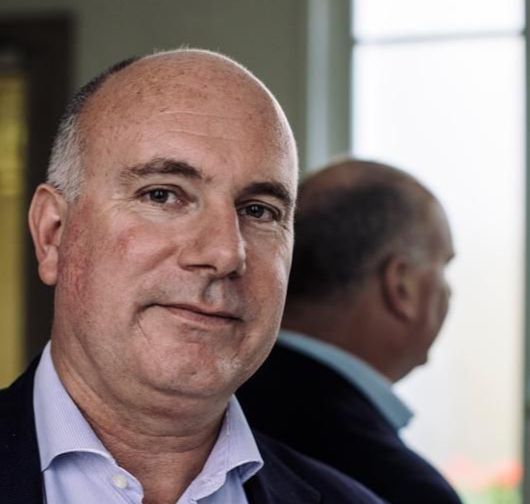
John Laughland
Director of Forum for Democracy International
John Laughland is an English author of numerous books and a lecturer in Political Science. He writes on international affairs and political philosophy and has contributed articles to The Guardian, The Spectator, the Brussels Journal, The Wall Street Journal, National Review, The American Conservative, and Antiwar.com. He was Director of the Euroskeptic think tank European Foundation until 2008 and Director of studies at the Institute of Democracy and Cooperation in Paris until 2018. He worked at the European Parliament from 2018 to 2020 and, since September 2021 has been on the teaching staff of the Catholic Institute of the Vendée in Western France where he is a lecturer in political science and history. He is currently Visiting Fellow at the Mathias Corvinus Collegium in Budapest.
Related articles
 Opinion
The Pillar, Cofnas, Ghent – the battle for the institutions
 Opinion
Who sustains our shared world? Part 2: Hannah Arendt and Frits Bolkestein on plurality, freedom and citizenship
 Opinion