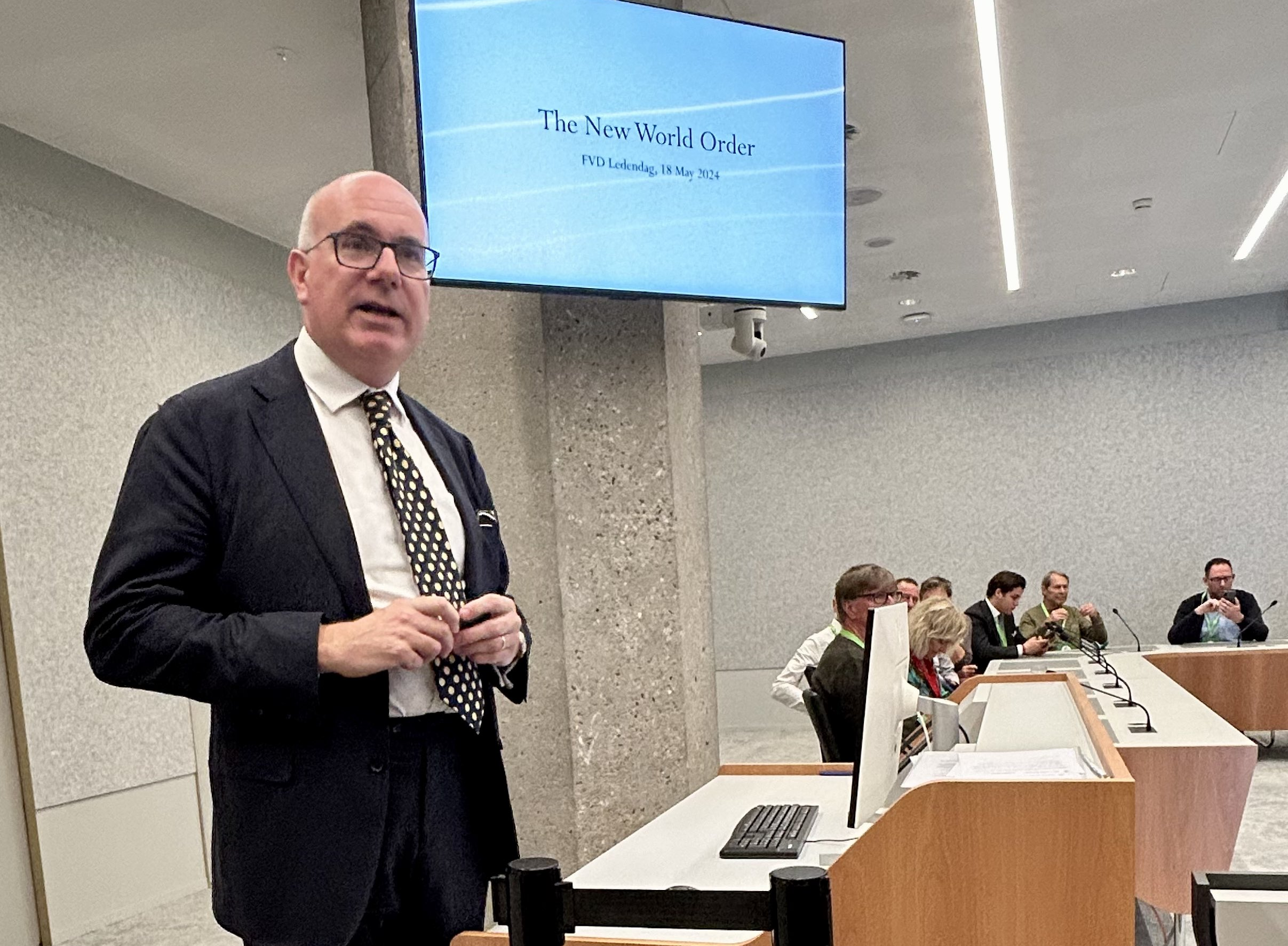
At the Members’ Day held in the Second Chamber of the Dutch Parliament on 18 May, FVD International director, John Laughland, gave an hour-long lecture on the seismic shift currently underway towards a new multipolar world order.
There are three principal elements to this:
- Political
- Economic
- Military
Politically, the Sino-Russian axis is stronger than ever. Putin’s recent visit to Peking only emphasized how deep the alliance is. The joint Russian-Chinese statement put out after the visit is a severe rebuke to both the EU and the US which had both tried to drive the two giants apart.
Economically, the West is losing ground. China overtook the USA as the world’s largest economy in 2015. More importantly, both China and Russia make things. The GDP figures for the USA are largely inflated by essentially unproductive economic activity – overpaid lawyers, for instance. When Western leaders laughed at Russia for having an economy the size of Spain’s, they were duped by misleading GDP figures. Sanctions have severely harmed Europe which is rapidly growing poorer relative to the USA whose per capita GDP is currently 80% higher than that of the euro zone, the two having been the same in 2008.
Militarily, NATO is losing in Ukraine. NATO is not used to, and unequipped for, fighting classic wars. It has fought counter-insurgency operations for the last 30 years - and often lost them. Russia has demonstrated industrial and military superiority – at the top end, hypersonic missiles are a game-changer but Russian shell production is three times that of the US and EU combined. This combination of industrial output, manpower (the Russian army has hundreds of thousands of men) and the capacity to wage a classical war, including a war of attrition, means that the writing is on the wall for NATO and the collective West.
The slides shown contain hyperlinks to the original sources.
The full presentation can be found here.
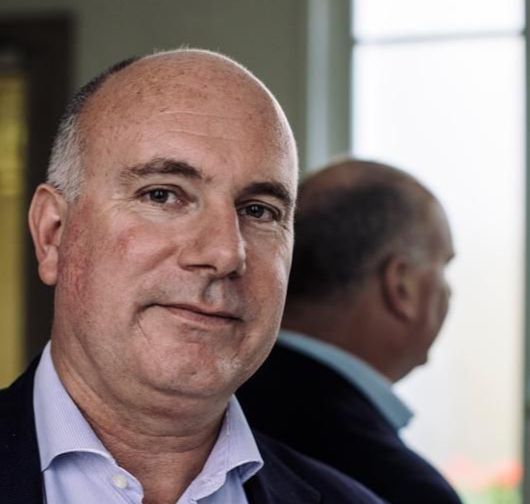
John Laughland
Director of Forum for Democracy International
John Laughland is an English author of numerous books and a lecturer in Political Science. He writes on international affairs and political philosophy and has contributed articles to The Guardian, The Spectator, the Brussels Journal, The Wall Street Journal, National Review, The American Conservative, and Antiwar.com. He was Director of the Euroskeptic think tank European Foundation until 2008 and Director of studies at the Institute of Democracy and Cooperation in Paris until 2018. He worked at the European Parliament from 2018 to 2020 and, since September 2021 has been on the teaching staff of the Catholic Institute of the Vendée in Western France where he is a lecturer in political science and history. He is currently Visiting Fellow at the Mathias Corvinus Collegium in Budapest.
Related articles
 World
WorldThe End of an Era: Time's Up for Orbán
 World
WorldThe War Against Iran: the Netherlands should stay out and look after its own people
 World
World