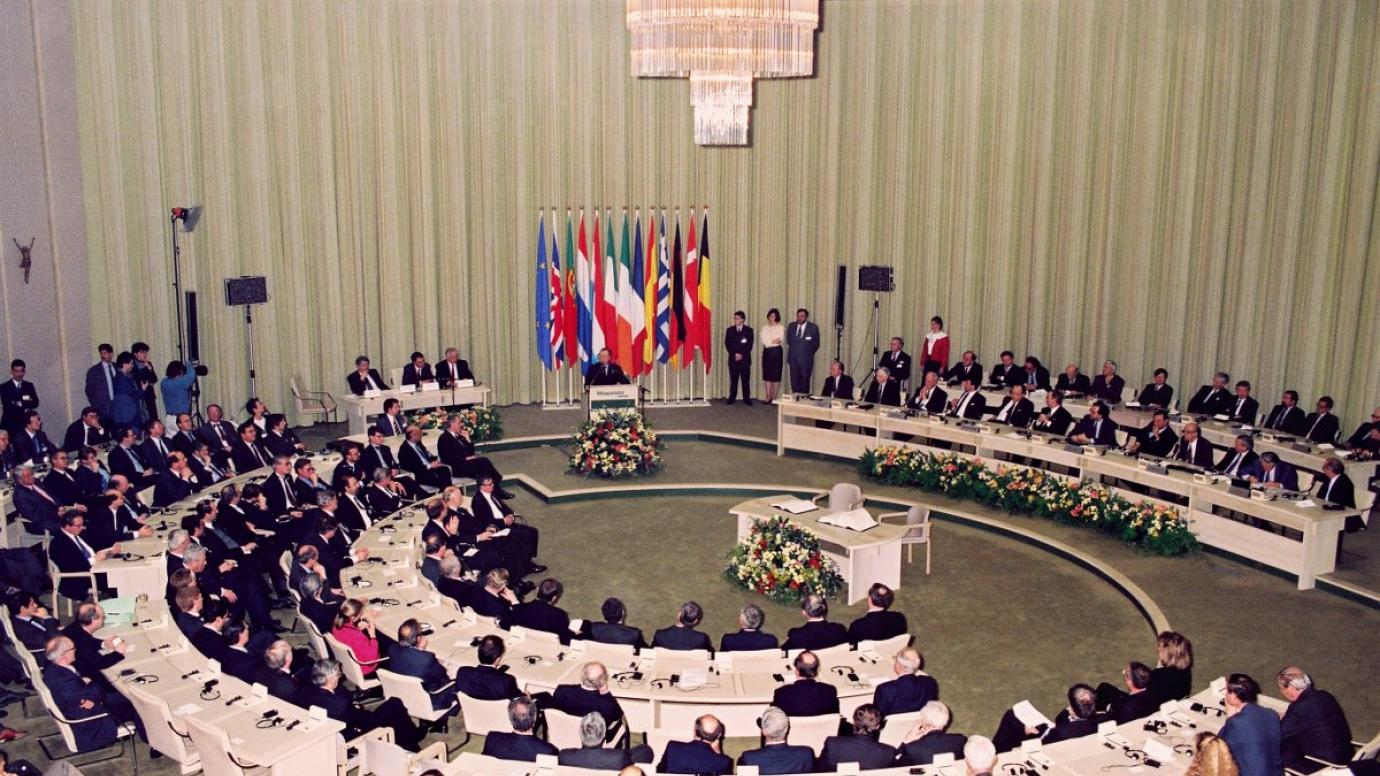
It is often forgotten that the Maastricht summit, which took place thirty years ago on 9 and 10 December 1991 (the treaty was formally signed on 7 February 1992) took two fateful decisions which were to affect the continent for a generation.
The first was to abandon national currencies and adopt the euro instead. The single currency duly came into being at the end of the decade, on 1 January 1999, the coins and notes entering into circulation two years later.
The goal was to remove a central plank of national sovereignty and identity and to create instead an artificial or virtual European identity – as artificial as the bridge and windows on the euro bank notes, which are purely invented and which have no real existence. To this extent, the euro is a perfect symbol of the EU: an unhistorical fairy tale which pretends it has made itself true.
Maastricht also took another decision, whose consequences were also to reach far into the future. Under unilateral German pressure[1], the then twelve member states of the European Community decided to recognise the independence of Croatia and Slovenia and thus to break up Yugoslavia. Fighting had broken out in the summer, not least thanks to Germany supplying arms to the rebels[2], but recognition fuelled the flames, especially in Bosnia where the war, which the Americans encouraged[3], was to last until 1995. By the end of the decade, a similar rebellion was supported by the West, this time in Kosovo, which led to Nato’s illegal bombing of rump Yugoslavia from March to June 1999 and eventually to the complete Balkanisation of the Western Balkans.
The Yugoslav wars were, from the Western perspective, both geopolitical and ideological – like Western foreign policy today which is specifically anti-Eastern, the ‘East’ being identified, in the fevered imagination of the post-modernists, with authoritarianism and reaction. The virulence with which Europe turned against the Serbs in this conflict was breath-taking, their cause being immediately presented as criminal in its very essence. The first international tribunal was created in May 1993, under US initiative[4], with the express aim of punishing Serbs. The existence of this tribunal was a major attack on the sovereignty-based system of the United Nations (even though it was the Security Council itself which set it up) and it was a key foundation-stone in the construction of a new supranational world order.
Where the Serbs were presented as both communist and nationalist, the Bosnian Muslims were elevated, by prophets of the New World Order like Bernard-Henri Lévy, to symbols[5] of post-national European cosmopolitanism. This was the beginning of islamo-gauchisme which continues to influence European politics even today[6] in spite of the outrages committed by Islamists since then (and in spite of outrages committed by Bosnian Muslims at the time, which were never publicised in the West[7]).
What made the Bosnian Muslim cause so compellingly attractive was their status of victimhood – that supposed victimhood which continues to be the determining pretext for radical leftism today, as shown by the BLM protests of 2020, or the obsession with outlandish causes like transgenderism.
The sheer novelty of the Bosnian Muslims’ claim to statehood, based as it was on no historical precedent and therefore on no objective reality, but instead only on their supposed ‘values’ of tolerance and on their status as victim, anticipated not only the support given to other artificial claims to statehood, such as those of Kosovo or Ukraine or even the EU itself, but also the phenomenon of bogus entities kept artificially alive for geopolitical reasons of which these three territories are perfect examples.
In each case, there are none of the characteristics of statehood, i.e. a people, a territory and a national consciousness rooted in history. Kosovo’s only possible claim to statehood is as part of a Greater Albania, but that project was always hushed up because it does not sound very victimy. Bosnia has always been home to different nationalities and the invention of a ‘Bosniak’ nationality is a con-trick designed to obscure the real source of the political identity of the Bosnian Muslims, Islam. Ukraine is a composite territory[8], a little bit like the old Yugoslavia but which, unlike that state, and unlike nearly all the other post-Soviet states, has never managed to stabilise any credible national identity. On the contrary, it is a disparate territory torn apart by competing Mafias.
Kosovo, Bosnia, Ukraine and the EU thus embody the same dream-like unreality which Eric Voegelin attacked as characteristic of modernity and which left-wingers like Eligio Resta, Gianni Vattimo or Jürgen Habermas love because they are based only on ‘free association’ and not on any unchosen or inherited objective facts. They are, in short, the very essence of revolutionary politics, pure products of the Marxian dictum that the role of the philosopher is not to understand the world but to change it.
If the ideological resemblance between these four entities is clear, their geopolitical function should be too. They are all battering rams directed against the East. The origins of the European Union lie, of course, in the Cold War, and in the US desire to consolidate a Western bloc by creating a mini-Soviet Union based in Brussels to draw public support away from the big Soviet Union based in Moscow.
Those origins were given a major boost in 1991 when the Maastricht summit was held the day after the proclamation of the dissolution of the USSR at a meeting in Soviet Belarus on 8 December 1991. The single currency and the destruction of Yugoslavia were both geopolitical acts designed to push hard into the gap which was opening up with the collapse of Russian power. In the euro’s case, the goal was to create a new centre of gravity in Germany around which all European states in both Western and Eastern Europe would orbit. In the case of the break-up of Yugoslavia, the deployment of brute force in 1995 and 1999 showed up the realities of power behind the bogus new European Union because the bombs were dropped not by any European army but instead by the true Ordnungsmacht, the US, acting through Nato to which the EU formally subjugated itself in the Lisbon treaty.
Built in the Cold War and dramatically enlarged after the end of it, the EU is nothing but an American bridgehead on the European continent. As Jean-Pierre Chvènement used to say, the United States of Europe is the Europe of the United States.
[1] https://www.nytimes.com/1991/12/12/world/germany-raising-hopes-of-croatia.html
[2] https://www.strategicstudies.org/reports/Balkan/Oct3192.htm
[3] https://www.mail-archive.com/[email protected]/msg05592.html
[4] https://heinonline.org/HOL/LandingPage?handle=hein.journals/dsptch6&div=228&id=&page=
[5] https://www.gettyimages.ch/detail/nachrichtenfoto/file-photo-dated-12-september-1992-shows-cellist-nachrichtenfoto/134244881?language=fr
[6] https://twitter.com/gunnar_beck/status/1488122713357320193
[7] https://www.reddit.com/r/MorbidReality/comments/q1jp64/bosnian_mujahideen_holding_a_decapitated_head_of/
[8] https://commons.wikimedia.org/wiki/File:Simplified_historical_map_of_Ukrainian_borders_1654-2014.jpg

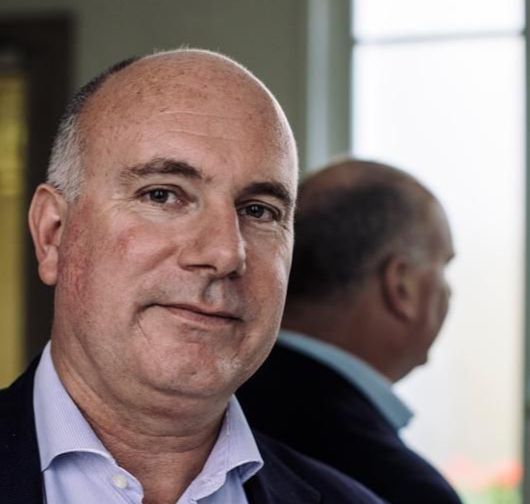
John Laughland
Director of Forum for Democracy International
John Laughland is an English author of numerous books and a lecturer in Political Science. He writes on international affairs and political philosophy and has contributed articles to The Guardian, The Spectator, the Brussels Journal, The Wall Street Journal, National Review, The American Conservative, and Antiwar.com. He was Director of the Euroskeptic think tank European Foundation until 2008 and Director of studies at the Institute of Democracy and Cooperation in Paris until 2018. He worked at the European Parliament from 2018 to 2020 and, since September 2021 has been on the teaching staff of the Catholic Institute of the Vendée in Western France where he is a lecturer in political science and history. He is currently Visiting Fellow at the Mathias Corvinus Collegium in Budapest.
Related articles
 World
WorldThe End of an Era: Time's Up for Orbán
 World
WorldThe War Against Iran: the Netherlands should stay out and look after its own people
 World
World